
Choosing the best Aluminum Mig Welder in 2026 means looking beyond advertised amperage. Aluminum conducts heat quickly, forms an oxide layer, and can punish inconsistent wire feeding. A machine that handles clean, thin sheet may struggle with thicker plate or long production runs. The International Aluminium Institute reported global primary aluminum production of about 72.8 million tonnes in 2024, underscoring the scale of this widely used material. Scale matters. Yet market size alone cannot tell you which welder will suit your workshop.
For practical guidance, welding educator Jody Collier emphasizes the fundamentals: “Clean metal, stable wire feed, and controlled heat make the difference.” Treat that as a shop-floor principle, not a substitute for checking a machine’s specifications or the manufacturer’s setup guidance. Compare spool-gun compatibility, AC or pulse features where relevant, duty cycle, and available support. The Aluminum Association’s industry research also documents aluminum’s substantial role in manufacturing and the economy; that context helps explain why equipment choices matter to fabricators. Still, published reports cannot test a welder on your actual joint. A bright bead can hide poor penetration. This guide weighs specifications against real working needs, including alloy, thickness, power supply, and operator experience, so you can make a more informed choice.
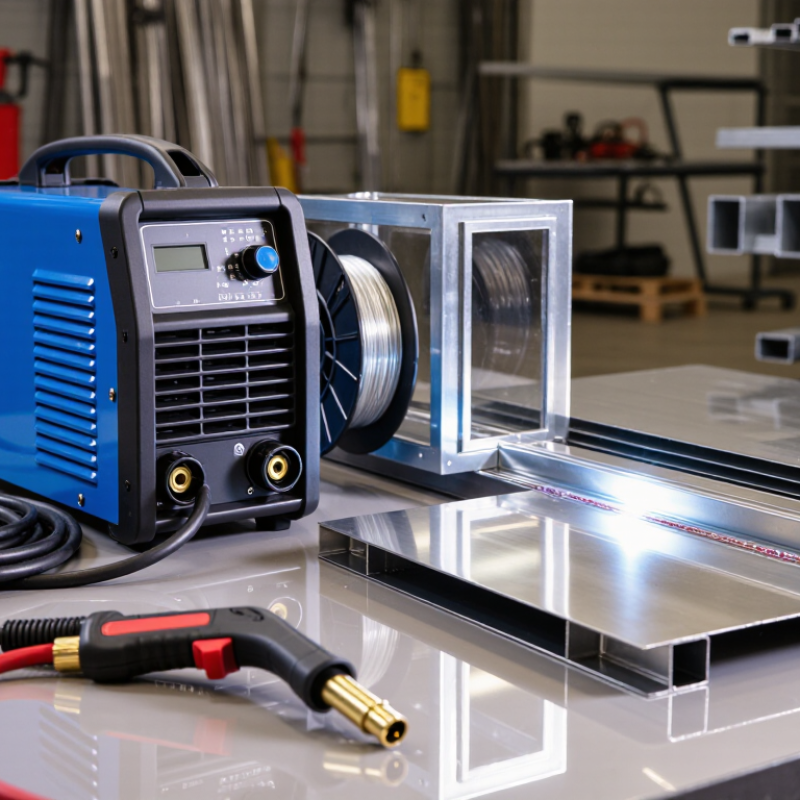
The best aluminum MIG welder depends on the alloy, thickness, and available power—not just its maximum amperage. Check the alloy and temper before choosing filler wire; 5xxx and 6xxx alloys may call for different filler choices. A filler chart or qualified welding procedure is safer than guessing.
For thin sheet, stable low-amperage control matters. A spool gun can also reduce soft-wire feeding problems.
On thicker plate, confirm the machine can sustain the required output, not merely reach it briefly.
Duty cycle changes what “sustain” means. IEC 60974-1 rates welding equipment over a ten-minute period, so a 40% duty cycle at a stated current allows four minutes of welding before cooling time. Check the rating at the amperage you actually need.
Small detail. It matters.
Input power matters too: verify the machine’s voltage and circuit requirements against the shop supply before buying.
ASM Handbook property tables list 6061-T6 aluminum’s thermal conductivity near 167 W/m·K at room temperature, helping explain why heat moves quickly through the workpiece. That figure is not a welding setting.
Fit the machine to the job, then test settings on matching scrap; even experienced operators sometimes need another pass at setup.
What Is the Best Aluminum MIG Welder in 2026?
Compare 120 V and 240 V MIG Output at Rated Duty Cycles
For aluminum, the best welder is not simply the one with the higher voltage. A 120 V machine can suit thin sheet and light repairs, but its usable output may limit thicker work. A 240 V model often offers more headroom for higher amperage and steadier welding on heavier sections. Compare each machine’s rated output at the amperage you actually need. Numbers need context.
Tips: Read the duty-cycle rating beside its stated amperage. A 30% rating typically means three minutes of welding within a ten-minute period, followed by cooling time. Ratings at different amperages are not directly comparable. Check the manual and your available power supply before choosing.
Aluminum also demands consistent wire feeding and clean material. A compatible spool gun or push-pull setup can help reduce feeding problems, especially with soft wire. In a workshop, a 240 V unit may feel less strained on longer beads, while a portable 120 V unit can be practical for occasional, lighter jobs. Still, I would not choose from voltage alone; published ratings do not tell the whole story about your joint, fit-up, or technique. Test on scrap of similar thickness, and note how often thermal protection interrupts your work.
What Is the Best Aluminum MIG Welder in 2026?
Choosing an aluminum MIG welder starts with the filler wire, not a feature list. AWS A5.10/A5.10M specifies ER4043 at 4.5–6.0% silicon and ER5356 at 4.5–5.5% magnesium. Those alloying elements affect cracking resistance, strength, and finished appearance. For many 6xxx-series parts, ER4043 flows smoothly and helps reduce solidification cracking. Its silicon-rich weld can look darker after anodizing, though. Small detail matters. ER5356 is often selected for 5xxx-series aluminum and applications needing higher weld strength. Its color can better match anodized 5xxx material.
Check the base-metal designation before loading a spool. ER5356 is generally unsuitable for prolonged service above 150°F (about 66°C), while ER4043 may be a better fit for some elevated-temperature applications. The Aluminum Association’s Aluminum Design Manual is a useful reference for identifying alloy families; AWS A5.10 provides the filler-metal classification data. Neither replaces the part specification or a qualified welding procedure. In practice, clean oxide, dry wire, and steady feeding still matter. A welder may have ample output, yet poor wire choice can leave a cracked bead. I still verify the alloy marking rather than relying on memory. It is easy to get that wrong.
Choosing the best aluminum MIG welder in 2026 starts with wire delivery, not a crowded feature list. Soft aluminum wire bends easily, so the feeding system can matter more than maximum amperage. A spool gun holds a small wire spool at the torch, keeping the wire path short and reducing feed problems. It suits occasional repairs and short seams. The added weight is real. Your wrist may tire during long welds.
A push-pull system uses a motor in the torch to pull wire while the feeder pushes it. This can deliver steadier feeding through a longer cable and suit repetitive work or larger projects. It also adds cost, weight, and parts to maintain. Compatibility matters: check that the gun, feeder, and welder are designed to work together. Neither system guarantees a clean bead; fit-up, clean material, and suitable settings still count. This is not a perfect rule, but a spool gun often makes sense for simple jobs, while push-pull offers more flexibility.
Tips: Test-feed the wire before striking an arc. Watch for tangles at the drive rolls, then check that the torch feels manageable in your hand. Small details matter.
| Setup Type | How It Feeds Aluminum Wire | Typical Spool Capacity | Best Suited For | Key Advantages | Trade-Offs | 2026 Buying Assessment |
|---|---|---|---|---|---|---|
| MIG power source with spool gun | A small wire spool sits in the gun, keeping the soft wire path short between the drive rolls and contact tip. | Commonly about 1 lb; capacity depends on the gun. | Home shops, repair work, occasional aluminum welding, and short-to-medium welds. | Reduces the distance soft aluminum wire travels, helping limit buckling and feeding problems. Usually straightforward to set up. | The gun is heavier than a standard MIG torch, and small spools require more frequent changes. Cable length and duty cycle can limit extended work. | Best all-around choice for many occasional users when the machine supports a compatible spool gun and the required output. |
| MIG power source with push-pull gun | Drive rolls in the machine push the wire while powered rolls in the gun pull it, maintaining more consistent wire tension over a longer path. | Often uses a larger machine-mounted spool; exact capacity is machine- and feeder-dependent. | Frequent production work, longer welds, and users who need a lighter hand-held gun or a longer reach. | Provides controlled feeding over greater distances and can reduce the need to change small gun-mounted spools. | Typically costs more and requires a compatible power source, feeder, controls, and gun. Setup and maintenance can be more involved. | Best for regular or higher-volume aluminum work when reliable feeding and longer welding runs justify the added system complexity. |
| Standard MIG torch with aluminum liner | The machine’s drive rolls push wire through the torch liner. A low-friction liner and correctly matched drive rolls and contact tip are important. | Usually supplied from the machine’s spool compartment; capacity varies by machine. | Short cable runs, smaller wire sizes, and experienced operators with a suitable feeder setup. | Can be a lower-cost option if the machine already supports aluminum wire and the torch path is short and properly configured. | Soft wire is more prone to bird-nesting or buckling in a long, curved feed path. Feeder setup and torch handling are less forgiving. | Best only for suitable short-path setups; confirm the machine and torch are designed to feed the selected aluminum wire reliably. |
| Spool gun vs. push-pull: feeding reliability | Both approaches are designed to improve feeding of soft aluminum wire compared with a long push-only path. | Depends on the selected gun and feeder. | Any application where wire-feed consistency is a priority. | Spool guns shorten the wire path; push-pull systems actively control wire movement at both ends. | Neither system removes the need for correct roll pressure, wire size, liner or guide setup, and contact-tip selection. | Choose based on duty cycle, weld length, gun handling, spool-change frequency, and compatibility—not feed method alone. |
| Power-source and compatibility checklist | Confirm that the power source, feeder, gun, and controls work together as a complete aluminum MIG system. | Check the machine’s stated spool and feeder limits. | All buyers comparing aluminum-capable MIG systems. | Review output range, rated duty cycle, input power, gun connection, wire-size compatibility, and available setup guidance. | A machine’s advertised maximum output does not by itself establish suitability for every material thickness or welding schedule. | Best choice: the system that matches the intended work and has a compatible spool-gun or push-pull feeding option. |
Note: Capacities and setup details are typical examples, not universal specifications. Verify the exact machine and gun manuals for supported wire diameters, spool sizes, input requirements, duty cycle, and compatibility before purchasing.
The best aluminum MIG welder in 2026 is not defined by amperage alone. Check that it supports 100% argon, the correct polarity, and stable wire feeding. Gas matters. Aluminum MIG normally uses pure argon; mixed gases can produce inconsistent arc behavior and poor results.
Confirm the cylinder label and regulator setup, then follow the wire and torch manufacturer’s flow guidance. Too little shielding exposes the weld pool, while excessive flow can create turbulence.
Polarity matters, too. Aluminum MIG generally requires DCEP: the torch is positive and the work clamp is negative. Verify the machine’s terminals rather than trusting a front-panel label. Look for a spool gun or push-pull compatibility, smooth drive rolls, and settings that handle the wire diameter and material thickness you actually use. A bird’s nest at the feeder is a costly clue.
For structural aluminum work, check whether AWS D1.2 applies to the project, contract, and governing specifications. The code may require qualified procedures and personnel; a welder’s feature list alone proves nothing. Clean oxide carefully, test on matching scrap, and inspect the bead. I still find setup details easy to underestimate. A short test weld can reveal more than a polished sales sheet.
Join our mailing list to receive the latest news and updates from our team.