
10 Best Magnetic Track Pendant Lights for 2026

Magnetic track pendant lights bring focused illumination to kitchens, dining areas, and workspaces without fixing every fitting in place. Their appeal is practical: move a pendant along the rail, adjust the composition, and create a pool of light over a table or countertop. The details matter, though. Track standards, adapters, dimming systems, and pendant weight can vary between manufacturers, so a sleek photograph alone is not enough to judge compatibility.

The wider market is growing. Grand View Research estimated the global LED lighting market at USD 75.1 billion in 2023 and projected a 10.4% compound annual growth rate from 2024 to 2030. That figure covers LED lighting broadly—not magnetic track pendants specifically—but it signals the expanding role of efficient, adaptable lighting. Lighting designer Ingo Maurer once said, “I am not interested in light. I am interested in the shadows.” His observation is a useful reminder: a pendant should shape a room, not merely brighten it.

This 2026 guide compares ten magnetic track pendant lights by design, light quality, adjustability, compatibility information, and everyday practicality. Look closely at the rail system and the bulb or LED specifications before buying. A beautiful fixture can still disappoint if its light feels harsh or its adapter does not fit. Some product listings also leave key details unclear. That deserves scrutiny. The selections below aim to make those trade-offs easier to see, while recognizing that the best choice depends on your room, ceiling, and preferred atmosphere.
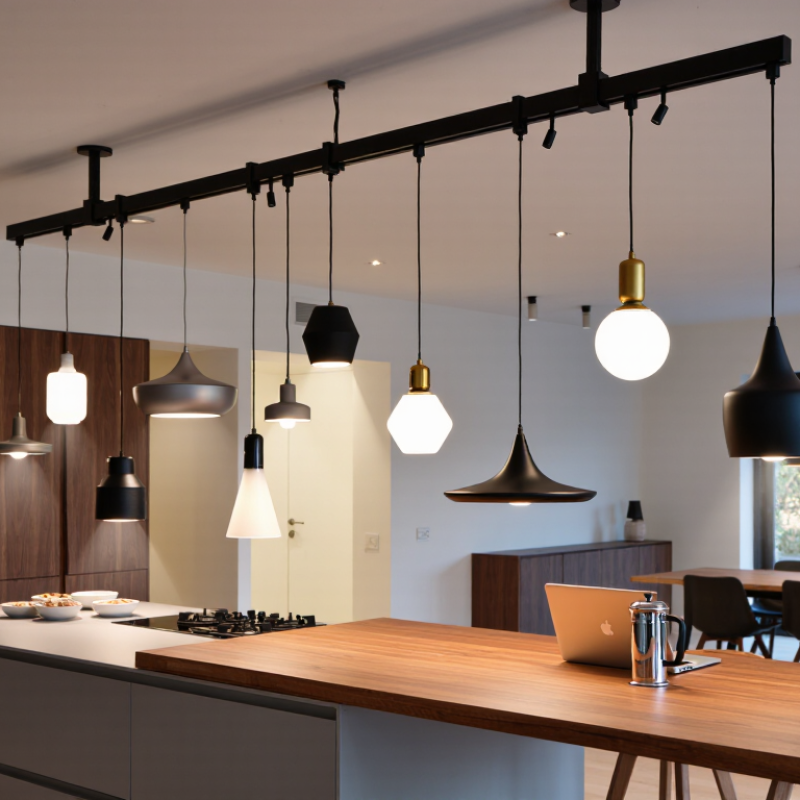
10 Best Magnetic Track Pendant Lights for 2026

What Magnetic Track Pendant Lights Are and How They Work

Magnetic track pendant lights are modular fixtures that attach to a powered rail through magnetic adapters. The track carries electricity, while magnets hold each pendant in place. Electrical contacts in the adapter connect the fixture to the track’s conductors. Depending on the system, a driver may convert household power to low-voltage current. Check the system’s voltage and adapter compatibility before choosing a pendant; magnetic attachment alone does not guarantee a universal fit.

Once attached, many pendants can slide along the rail or be repositioned without rewiring. That makes it easier to center a light over a dining table or shift it above a kitchen island. The connection should feel secure, but installation details vary. Follow the manufacturer’s instructions, and have a qualified electrician handle wiring when needed. Not magic.

Efficiency depends on the light source, not the magnet. The U.S. Department of Energy’s Energy Saver guidance says LED bulbs use at least 75% less energy and last up to 25 times longer than incandescent bulbs. Still, a movable pendant can be aimed poorly or placed where it creates glare. Stand beneath the fixture and check the light on the work surface. Small adjustments matter.

Key Features to Consider When Choosing a Pendant Light

For magnetic track pendant lights, check compatibility before comparing appearance. The pendant must match the track system’s voltage, connector, and rated load. A neat-looking fitting is not useful if it cannot attach securely. Look for adjustable suspension cables, especially above kitchen islands or dining tables. They make it easier to keep the shade at a comfortable height. Also consider beam angle: a narrow beam highlights a countertop, while a wider one spreads light across a table.

Tips: Measure the track and table before ordering. Check that the pendant can be dimmed with your existing control. Warm light often feels inviting in dining areas, while a higher color rendering index helps food and finishes look more natural. Small specifications matter.

Think about glare, cleaning, and daily use, not just the product photo. An exposed bulb may look striking but can shine directly into seated eyes. A shade can soften the light, though some designs leave dark patches nearby. That trade-off is easy to overlook. Read the installation instructions and have a qualified professional assess the track and electrical setup when needed. Finish, size, and brightness are personal choices; a fixture that feels balanced in a showroom may look oversized in a compact room. Check dimensions carefully, and leave room to reconsider.

10 Best Magnetic Track Pendant Lights for 2026 — Key Features to Consider When Choosing a Pendant Light

No. Pendant Type Typical Power / Light Output Useful Color & Beam Options Best For Key Checks Before Buying
1 Compact downlight pendant About 5–10 W; roughly 300–800 lm Typically 2700–4000 K; narrow or medium beam, around 20°–40° Kitchen islands, counters, and small accent areas Check glare control, beam spread, hanging height, and whether the output is sufficient for the task.
2 Linear pendant About 10–25 W; roughly 700–2,000 lm Commonly 2700–4000 K; broad downward distribution Long islands, dining tables, and work surfaces Compare fixture length with the surface below and confirm that the track can support its weight.
3 Opal globe pendant About 5–15 W; roughly 400–1,200 lm Often 2700–3500 K; soft, wide-area light Dining areas, reception spaces, and decorative ambient lighting Check globe diameter, diffuser material, cleanability, and whether the lamp is replaceable.
4 Adjustable spot pendant About 5–15 W; roughly 350–1,200 lm Commonly 2700–4000 K; focused beam, often around 15°–40° Artwork, display shelves, and directional accent lighting Look for a useful aiming range and shielding that limits direct view of the light source.
5 Diffused cylinder pendant About 8–20 W; roughly 600–1,600 lm Often 3000–4000 K; medium-to-wide downward light General task lighting in kitchens, studios, and offices Compare lumen output and diffuser design; a higher wattage alone does not guarantee more light.
6 Decorative ring pendant About 8–25 W; roughly 500–2,000 lm Typically 2700–4000 K; direct, indirect, or combined output Living areas, dining rooms, and feature lighting Check ring diameter, light direction, dimming behavior, and clearance from nearby objects.
7 High-CRI task pendant About 8–20 W; roughly 600–1,600 lm Choose CRI 90 or higher; commonly 2700–4000 K Food preparation, craft work, and spaces where color accuracy matters Verify the stated CRI and color consistency; higher CRI does not by itself indicate higher brightness.
8 Tunable-white pendant About 8–20 W; roughly 600–1,600 lm Adjustable white light, often within approximately 2700–5000 K Multi-use rooms and spaces that need different lighting moods Confirm how color temperature is controlled and whether the control system matches the track and driver.
9 Low-glare louvered pendant About 8–20 W; roughly 500–1,500 lm Usually 3000–4000 K; controlled downward distribution Desks, meeting tables, and screen-heavy work areas Check louver depth, viewing angles, and installation position to reduce reflected glare on screens.
10 Multi-light cluster pendant About 12–40 W total; roughly 800–3,000 lm Commonly 2700–3500 K; multiple points of light Large islands, stairwells, and decorative focal points Check total load, pendant spacing, suspension lengths, and whether each light can be positioned independently.

Specifications above are typical selection ranges, not guaranteed ratings for a particular fixture. Before purchasing, confirm the pendant’s voltage, track profile, electrical load, driver, and dimming method are compatible with the installed magnetic track system. Lumens, color temperature, CRI, and dimensions vary by model.

The 10 Best Magnetic Track Pendant Lights for 2026

The 10 Best Magnetic Track Pendant Lights for 2026 should suit real rooms, not just polished product photos. A useful shortlist compares ten practical strengths: focused island lighting, soft dining-room glow, adjustable drop lengths, compact shades, wide diffusers, glare control, high color accuracy, dimming, easy repositioning, and clear installation instructions. Check track and pendant compatibility before buying; magnetic systems are not automatically interchangeable. For food preparation, look for even light across the counter and a shade that does not shine directly into your eyes. One trade-off is easy to miss: a striking pendant can still leave dark patches.

Energy use matters, too. The U.S. Department of Energy reports that residential LEDs use at least 75% less energy and can last up to 25 times longer than incandescent lighting. Those figures describe LEDs broadly, not every magnetic pendant, so verify each fixture’s rated power, expected life, and replaceable components.

Color rendering also deserves attention. A high CRI rating can help food, wood, and fabric look more natural, though it does not guarantee pleasing light.

Tips Measure the table or island, ceiling height, and track position before choosing. Hang shades high enough to keep sightlines clear, then test dimming at night. Save the specification sheet. It can prevent a costly mismatch.

How the Top Pendant Lights Compare in Design and Performance

Magnetic-track pendant lights differ most in how cleanly they balance visual shape and usable light. A narrow cone can make a kitchen island feel focused, while a shallow dome spreads light across a wider table. Compare beam angle, color temperature, color rendering, and glare control—not just the fixture’s finish. Small details matter. Check whether the pendant’s adapter locks firmly onto the track and whether its height can be adjusted without tools.

Performance claims need context. The U.S. Department of Energy’s LED guidance reports that LEDs use at least 75% less energy and can last up to 25 times longer than incandescent lighting. ENERGY STAR’s LED guidance gives a similar efficiency benchmark, but product life varies with heat, driver quality, and operating hours. Those figures describe LED lighting broadly, not every magnetic-track pendant. A compact fitting may run efficiently yet feel harsh over a glossy countertop. Not always.

For a fair comparison, note wattage, delivered lumens, dimming range, and compatibility with the track’s power supply. The Illuminating Engineering Society’s lighting recommendations emphasize matching light levels to the task and space, so a pendant’s lumen figure alone cannot predict comfort. Try a warm-white option over wood, then inspect the same light against pale stone; color can shift noticeably. A showroom test helps, though its bright ceiling may hide glare that appears in a quieter home. I would still verify replacement-driver availability before choosing a sleek, sealed design.

10 Magnetic Track Pendant Light Styles for 2026

A comparison of representative pendant styles using an indicative 0–100 design-and-performance score.

Scores are illustrative editorial ratings, not laboratory measurements or specifications for particular products. They summarize typical considerations such as light distribution, glare control, adjustability, and suitability for common spaces; actual performance varies by fixture.

Track Compatibility, Installation, and Safety Essentials

A magnetic pendant can look compatible because its adapter snaps onto a track, but the magnet alone proves very little. Check that the track and pendant use the same system, voltage, connector, and polarity. Some tracks rely on a separate driver, while others have different electrical designs. Read the product specifications together, not just the pendant listing. Also confirm the track’s rated load can support every fixture on it. Small details matter.

The awkward part is that compatibility can be hard to judge from photos. Ask the seller or a qualified electrician when documentation is unclear; do not force an adapter that resists seating. Installation should follow the system instructions, with power isolated at the breaker and verified by a professional before wiring. The track must be fixed securely to suitable structure, not merely a loose ceiling panel. Keep pendants clear of curtains and other materials, and check that their heat and drop length suit the room. A slightly uneven ceiling can complicate alignment, so measure twice. It is easy to overlook. After installation, test the fittings and dimmer at low brightness, then check for flicker, looseness, or unusual warmth.

Subscribe To Our Newsletter

Join our mailing list to receive the latest news and updates from our team.

You have Successfully Subscribed!