What Is the Best Power Inverter for Home Use?
Choosing the best Power Inverter For Home use starts with a simple question: what must stay on when the power fails? A refrigerator may draw modest power while running, then demand a sharp surge at startup. Add a router, a few LED lamps, and a medical device, and the required capacity changes quickly. A large number on a product box is not enough. You also need to check continuous output, surge rating, waveform, battery voltage, and the appliances’ combined load.
Residential power-systems engineer Marcus Hale puts the core idea this way: “Size the inverter for the loads you need, not the number that looks impressive.” That is a useful rule, though sizing still takes careful checking. A pure sine wave model generally suits sensitive electronics and many household appliances. A modified sine wave unit may cost less, but some motors can run hotter or noisier. Small details matter. Look for clear overload protection, accessible wiring information, and a low-voltage alarm you can actually hear in a utility room. Match the inverter to a compatible battery and follow the manufacturer’s installation guidance; poor connections can waste power and create heat.
This guide compares inverter types, capacity, battery compatibility, and practical safety features. It also looks at real household scenarios, from keeping a modem online to powering a refrigerator during an outage. The “best” choice is not always the biggest or cheapest. It may be the one that fits your home, budget, and backup needs—with enough margin for startup surges. One limitation remains: without a measured load list, any recommendation is only a starting point.
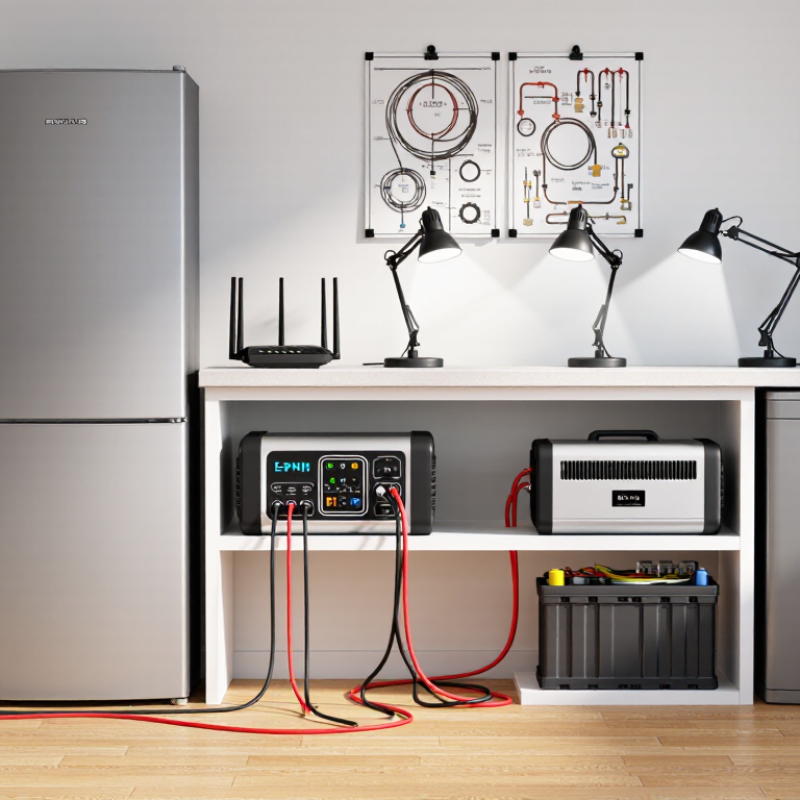
Define Home Inverter Types: Grid-Tied, Off-Grid, and Hybrid
The best home power inverter depends on how your home connects to the grid and what you need powered. Grid-tied inverters convert solar electricity for household use and can send excess energy back to the grid. During a blackout, most shut down automatically to prevent electricity from flowing into utility lines. That safety feature surprises some homeowners.
Off-grid inverters work without a utility connection. They draw stored energy from batteries, so battery capacity and charging options matter as much as inverter output. A refrigerator may use modest power while running but demand a brief surge when its compressor starts. Check both continuous and surge ratings. Small details count.
Hybrid inverters can connect to solar panels, batteries, and the grid. They may keep selected circuits running during an outage, depending on the system design and settings. This can suit homes seeking backup without disconnecting from utility power. Still, “hybrid” does not automatically mean whole-home backup; heavy appliances may exceed available capacity. A common planning miss is sizing for average use instead of peak demand. I’d also check which circuits matter most before comparing inverter types. The answer is less tidy than a single “best” choice.
Compare Conversion Efficiency: Many Models Exceed 90% at Rated Load
For home use, an inverter advertised above 90% efficiency can waste less energy as heat at its rated load. But that figure is not a promise for every appliance or every hour. A fridge compressor starting, for example, draws a brief surge that can change operating performance. Check both continuous and surge ratings.
NREL’s PVWatts Version 8 documentation uses 96% as the default nominal inverter efficiency in its grid-connected solar model. That is a modeling assumption, not a guarantee for a particular home inverter. NREL’s Sandia inverter model also accounts for changing power and voltage, reflecting an important point: efficiency shifts with operating conditions. At very light loads, an inverter may perform less efficiently, even if its rated-load figure looks excellent. Heat matters. Ventilation does too. I would compare efficiency figures only when the test conditions are clear; product sheets do not always make that easy.
Tips: Match the inverter’s continuous rating to the devices you expect to run together. Leave room for startup surges, and keep airflow around the unit. If possible, compare efficiency at both full and partial loads before buying. A watt meter can also reveal how much power your actual setup draws.
Check Battery Voltage, Capacity, and Inverter-Charger Compatibility
A home inverter should match the battery’s DC voltage, not just the appliances’ wattage. A 12-volt battery needs an inverter designed for that voltage; connecting mismatched equipment can cause shutdowns or damage. Then check continuous output and surge capacity. A refrigerator may draw much more power when its compressor starts. Add the running watts of essential devices, then allow headroom for startup surges. Small details matter.
Capacity is a separate calculation. Multiply battery volts by amp-hours, then divide by 1,000 for nominal kilowatt-hours. Usable energy will be lower after discharge limits and conversion losses. NREL’s 2024 Annual Technology Baseline models utility-scale battery round-trip efficiency at about 85%; this is a planning benchmark, not a promise for a home system. NREL’s PVWatts documentation uses 96% as a default for modeled solar inverter efficiency, but that figure is not interchangeable with a battery inverter-charger’s rating. Check the charger’s battery chemistry setting, charge voltage, current limit, and battery-management-system compatibility. A neat spec sheet can still hide a mismatch. I would verify the exact battery and inverter manuals before buying, especially when communication cables or specific charging profiles are required.
Verify Grid-Interactive Models to UL 1741 and IEEE 1547-2018
For a grid-interactive home inverter, “best” means more than matching your panels and battery. It must connect safely and behave predictably when utility conditions change. Check that the exact model number—not merely the product family—is listed or certified to the applicable UL 1741 requirements. Ask for documentation showing how it meets IEEE 1547-2018 interconnection requirements. That detail matters.
IEEE 1547-2018 covers how distributed energy resources interact with the electric grid, including responses to voltage and frequency changes. UL 1741 addresses inverter safety and relevant grid-interconnection functions. Look for test or certification records that identify the model and applicable functions. Not just a label. A sales page may use broad wording, while the actual certificate applies only to certain configurations or firmware versions.
Before buying, ask your installer or utility to confirm the inverter’s approval for your service area. Requirements and accepted settings can vary. Check that grid-support settings, such as voltage and frequency response, will be configured during commissioning. Keep the certificate and final settings with your system records. The paperwork can be frustratingly unclear, so ask for the exact document rather than relying on a verbal assurance. A backup-only inverter may not be designed for parallel operation with the grid; confirm its intended use before comparing it with grid-interactive models.