
Choosing the right Shelf Racking system in 2026 starts with the work it must support, not its appearance in a product catalogue. A warehouse storing uniform pallet loads has different needs from a parts room holding cartons, tools, and irregular items. Selective pallet racking offers direct access to individual pallets, while longspan shelving suits many hand-picked goods. Mobile systems can make better use of floor space, but they require careful planning around access and daily operations.
The useful comparison is practical: measure clear height and aisle width, check the heaviest expected load, and consider how goods move from receiving to dispatch. Forklift type, picking frequency, stock turnover, and room for future changes all affect the choice. Details matter. A rack that fits on paper may obstruct a turning forklift or leave awkward gaps beside a packing bench. Verify load ratings with the supplier, and follow the installation and inspection guidance provided for the specific system. One easy assumption is that denser storage is always better. It may not be; slower access or difficult replenishment can offset the space saved. This guide examines common racking types, their strengths, limitations, and suitable uses, so readers can compare options against real operating needs. The right answer depends on the building and the people using it. That deserves a second look.
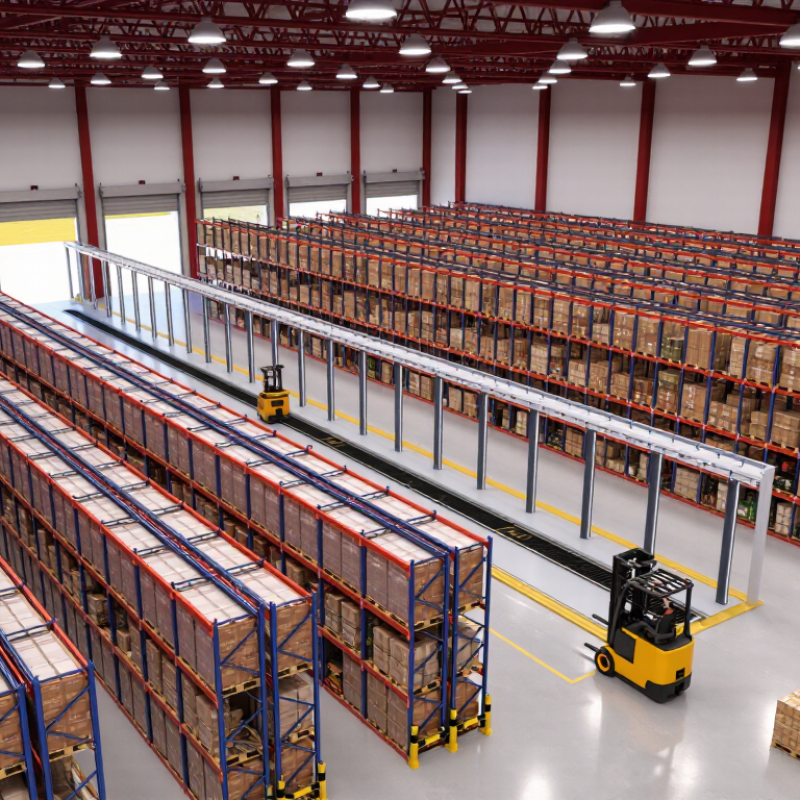
Shelf racking is a freestanding storage structure that uses horizontal shelves to hold cartons, bins, and small items. Upright frames carry the load, while shelf levels create accessible locations for inventory. Unlike pallet racking, it is generally suited to hand-picked goods rather than forklift-handled pallets. It helps warehouses use vertical space, group products by type, and keep picking locations visible. That can mean fewer cartons on the floor and faster access to frequently ordered items.
The right layout depends on product weight, dimensions, picking frequency, and available aisle space. Adjustable shelves accommodate changing stock, while heavier-duty systems suit denser loads. MHI’s 2024 Annual Industry Report found that 55% of surveyed supply-chain professionals planned to increase technology investment. Racking is not automation, but clear, consistently labeled shelf locations can support accurate inventory tracking as warehouse systems evolve. A plan may look efficient on paper and still slow pickers if shelf heights or aisles do not match real tasks.
Tips: Keep heavy items at waist level where practical, label each location clearly, and check load limits before storing stock. Leave room for safe access. Small gaps matter. Review the layout after seasonal changes; what worked for one product mix may not work for the next.
Which Shelf Racking Types Are Available in 2026?
The main options range from hand-loaded shelving to systems designed for high-volume picking. Boltless shelving suits small cartons, tools, and back-room stock; its adjustable shelves make changes simple, though heavy bins can strain light-duty frames. Long-span shelving holds wider or bulkier goods, such as boxed appliances or bins. Check the load rating, not just the shelf depth.
Carton-flow racking uses sloped rollers to move cases forward as workers pick them. It can speed up replenishment, but poorly matched cartons may jam. Mobile shelving runs on movable bases, saving aisle space while making access slower. Selective pallet racking serves palletized inventory rather than ordinary hand-picked shelf stock, so it may not fit every layout. The 2024 MHI Annual Industry Report found that 55% of respondents planned to adopt robotics and automation within five years. That figure is not a rack-selection rule, but it signals why clearances and future equipment plans matter. Measure the actual cartons, aisle width, floor condition, and expected load before choosing. It is easy to overlook the awkward, slow-moving items. That mistake can cost space.
What Are the Best Shelf Racking Types in 2026?
How the Main Racking Types Compare in Capacity and Access
Selective pallet racking gives workers direct access to every pallet, but its aisles use valuable floor space. Drive-in racking stores pallets several positions deep, increasing density while limiting access to individual loads. Double-deep systems add storage depth, though they require suitable reach trucks. Push-back racks suit last-in, first-out handling; pallet-flow racks support first-in, first-out movement. No single winner. A capacity-per-square-foot ranking can mislead if it ignores picking speed and equipment.
MHI’s 2024 Annual Industry Report surveyed more than 1,000 supply-chain professionals. It reported that 55% planned to adopt robotics and automation. That figure measures technology plans, not rack capacity, but it highlights the need to consider aisle access when planning automation. Actual rack capacity depends on the structure, beam levels, pallet loads, floor conditions, and installation. The ANSI MH16.1 standard provides engineering guidance for industrial steel storage racks; use qualified design review rather than generic capacity estimates.
Tips: Measure the pallet and load, then check the forklift’s turning radius. Walk the proposed route with a loaded pallet. A beam label is useful, but it cannot fix poor layout assumptions. Leave room for inspection, too. Real sites are rarely as tidy as drawings.
| Racking type | Typical capacity profile | Access to each load | Storage density | Best suited to | Main trade-off |
|---|---|---|---|---|---|
| Boltless / bin shelving | Low to medium; designed for cartons, bins, and hand-loaded items. Shelf ratings vary by span, material, and support. | Excellent; items are generally directly reachable from the aisle. | Low to medium | Small parts, picking areas, archives, and light-duty storage | Not intended for forklift-handled pallet loads or heavy industrial loads unless specifically engineered for them. |
| Longspan shelving | Medium; supports heavier or bulkier hand-loaded goods than typical light-duty shelving. Capacity is specified per shelf level. | Excellent; usually provides direct access to every stored item. | Low to medium | Bulk cartons, components, and manual-picking operations | Uses more aisle and floor space than high-density pallet systems. |
| Selective pallet racking | High; commonly engineered for pallet loads in the thousands of pounds per position, subject to beam, frame, height, and load configuration. | Excellent; each pallet position is accessible from the aisle. | Low to medium | Wide SKU variety, mixed inventory, and frequent stock rotation | Requires more aisles than systems that store pallets several positions deep. |
| Double-deep pallet racking | High; each position is engineered for its specified pallet load. The rack configuration does not automatically increase the rated capacity of each position. | Moderate; the rear pallet is reached through the front position, typically with a deep-reach truck. | Medium to high | Multiple pallets per SKU and operations seeking a balance of density and selectivity | Some pallets are less directly accessible, and specialized handling equipment is usually required. |
| Drive-in / drive-through racking | High; rails and frames are designed for the specified pallet loads and forklift operating conditions. | Limited; forklifts enter storage lanes, so pallets within a lane are not individually accessible from the aisle. | High | Large quantities of relatively few SKUs; drive-through layouts can support loading and unloading from opposite ends. | Lower selectivity and greater care needed during forklift operation inside lanes. |
| Push-back racking | High; load capacity is set by the engineered rack and cart system, including the number and weight of pallets per lane. | Moderate to limited; pallets are accessed from the aisle, but deeper pallets are retrieved in last-in, first-out order. | High | Several pallets per SKU where compact storage and aisle-side loading are useful | Inventory rotation is generally LIFO, and the system has more moving components than selective rack. |
| Pallet flow racking | High; lane capacity depends on the engineered rack, rollers, brakes, pallet specification, and load weight. | Good at the pick face; pallets move toward the unloading end, generally supporting first-in, first-out rotation. | High | High-throughput operations with multiple pallets per SKU and FIFO requirements | Higher system complexity; pallet condition and compatibility with the flow lanes matter. |
| Cantilever racking | Medium to high for long or awkward loads; arm and column ratings depend on load length, weight distribution, and rack design. | Good; open-front arms allow access along the length of stored goods. | Low to medium | Timber, pipe, furniture, and other long or irregular items | Not a general-purpose choice for standard pallet storage; long loads need suitable handling equipment. |
Capacity figures and ratings are system-specific. Confirm the rack’s posted load limits and obtain a qualified design for the actual load, pallet, layout, and operating equipment. Density and access descriptions are comparative, not engineering ratings.
What Are the Best Shelf Racking Types in 2026?
Which Shelf Racking Type Fits Each Storage Need?
Choose shelving for hand-picked cartons, bins, and small parts. Long-span shelving suits heavier boxes that workers still lift by hand. Small-item shelving keeps labels and quantities visible at the pick face. Measure the largest carton, not just the average one. A few oversized boxes can quietly ruin a tidy layout.
Selective pallet racks fit varied products that need direct access to each pallet. They work well when stock changes often, though aisles use valuable floor space. For many identical pallets, drive-in racks increase density by letting forklifts enter storage lanes. That trade-off matters: fewer aisles mean less immediate access. Push-back racks offer another dense option, while gravity-fed carton flow can support first-in, first-out picking when replenishment and order picking happen from opposite sides.
Long goods need cantilever racks, with arms supporting items such as pipe or timber without obstructive front posts. For fragile or awkward products, verify support spacing and handling needs before choosing. The MHI and Deloitte 2024 Annual Industry Report says 55% of surveyed organizations planned to increase supply-chain technology investment. That figure does not prescribe a rack type, but it points to a practical question: will the layout still work with planned picking technology? I would test a small section first. Real cartons behave oddly. Check load ratings, floor capacity, and forklift clearances with qualified professionals before installation.
Compare common rack types by the storage need they typically suit best.
Ratings are qualitative fit scores from 1 (limited fit) to 5 (strong fit), based on typical system characteristics—not load ratings or guaranteed performance. Final suitability depends on item dimensions, load requirements, handling equipment, and layout.
Choosing shelf racking starts with the load, not the catalog. Measure the heaviest carton, the widest container, and the items workers handle most often. Boltless shelving suits light, hand-picked goods; long-span shelving supports larger boxes and small equipment. For dense stock, mobile shelving can save aisle space, but it needs stable floors and clear operating rules. Keep heavy items low. Always.
Check the rack’s rated capacity against real loads, including how weight is distributed across each shelf. Leave enough aisle width for people, carts, and turning corners; a tightly packed layout can slow picking and create awkward lifting. Inspect upright frames, connectors, and shelves regularly, especially after a rack is moved or struck. Follow the supplier’s installation guidance, and have a qualified professional assess uncertain loads or layouts. Small damage matters.
Cost includes more than the purchase price. Compare installation, adjustments, access time, and future expansion. Fixed shelving may cost less upfront, while adjustable systems can adapt when carton sizes change. Measure a sample bay before ordering a full run. It is easy to underestimate how much space handles and open doors need. And forecasts are often wrong. Leave some room to revise the layout as stock patterns become clearer.
Join our mailing list to receive the latest news and updates from our team.