
China Best Forged Round Rings Manufacturer and Supplier

Forged Round Rings serve demanding roles in turbines, pressure vessels, heavy equipment, and other critical assemblies. Their reliability begins with material selection and continues through heating, forging, heat treatment, and inspection. A flawed grain flow or overlooked surface defect can affect service life. Small details matter.

The scale of steel production provides useful context, not a direct measure of ring demand. World Steel Association’s World Steel in Figures 2025 reports that global crude steel production reached about 1.88 billion tonnes in 2024. That figure signals a vast industrial materials base, but it does not tell buyers which ring dimensions or grades are available. Specifications still decide.

Taiichi Ohno, the manufacturing pioneer, is often credited with saying, “Without standards, there can be no improvement.” The principle fits ring procurement: clear drawings, traceable material records, and agreed inspection criteria make supplier comparisons more meaningful. For buyers searching for a China Best Forged Round Rings Manufacturer and Supplier, these checks matter as much as price. Ask about forging capacity, quality controls, documentation, and experience with the required application. Verify claims against project needs. No supplier should be judged by a polished brochure alone. Supplier capability varies, and even a strong process can leave room for improvement.
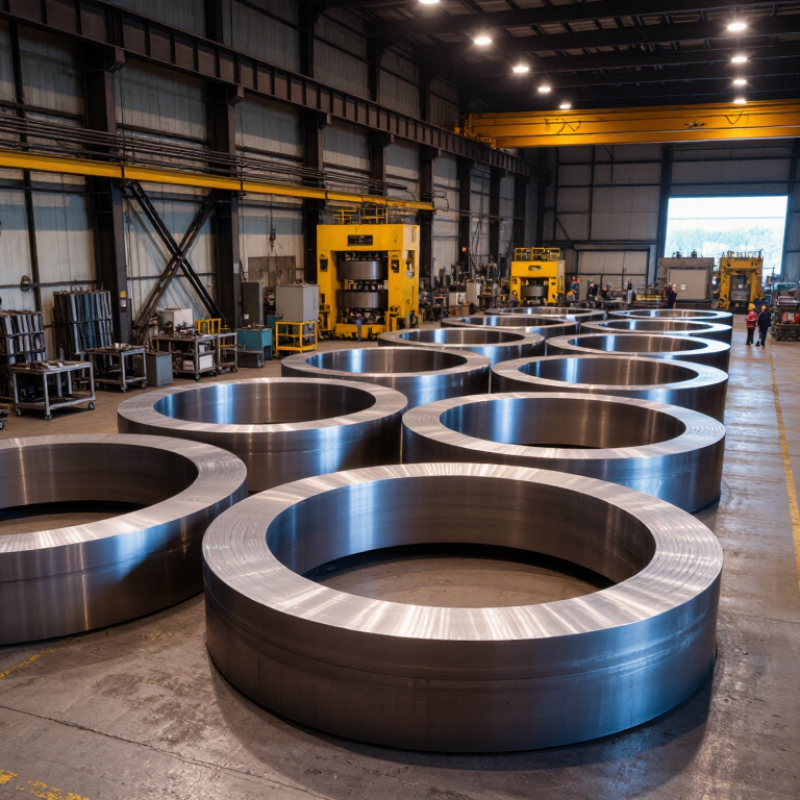
China Best Forged Round Rings Manufacturer and Supplier

China’s Forged Round Ring Industry: Products, Markets, and Supply Scope

China’s forged round ring industry serves equipment builders, repair workshops, and infrastructure projects. Products range from compact rings for machinery to large, heavy sections used in demanding structural applications. Buyers often specify steel grade, outer diameter, wall thickness, and machining allowance before production begins. Details matter.

Manufacturing typically involves heating a billet, forming it under pressure, and controlling cooling and heat treatment. These steps influence grain structure, strength, and dimensional stability. Practical checks may include measuring roundness, inspecting surfaces for visible defects, and reviewing material and test records.

A polished surface alone proves little. Ring quality depends on the full process.

Supply scope can include raw forging, heat treatment, rough or finish machining, inspection, and export packing. Customers in energy, construction, transportation, and general engineering may need different tolerances and documentation.

Reliable suppliers clarify drawings, production capacity, lead times, and inspection requirements early. They should also explain what testing is included, rather than leaving assumptions in a quotation.

Delays can still happen when specifications change, and that reality deserves honest discussion. Clear communication helps buyers compare offers and plan installation without relying on vague claims.

Steel Grades for Forged Rings: 42CrMo4, 34CrNiMo6, and ASTM A668

China Best Forged Round Rings Manufacturer and Supplier

Steel grade selection affects a forged ring’s strength, toughness, and response to heat treatment. 42CrMo4 is a chromium-molybdenum steel often supplied quenched and tempered. It suits many demanding applications where strength and machinability must be balanced. Check the finished ring’s section size, since cooling rates can vary from the surface to the core. A material certificate should confirm chemistry and mechanical test results.

For heavier loads or impact, 34CrNiMo6 offers nickel, chromium, and molybdenum in its alloy composition. These elements support hardenability and toughness, but the required properties depend on forging size and heat-treatment practice.

There is no perfect grade. A grade name alone cannot prove the ring will perform as intended.

ASTM A668 covers carbon and alloy steel forgings for general industrial use, with requirements organized by class. It is a specification, not one fixed steel chemistry, so buyers should state the required class and applicable tests.

For any grade, clarify dimensions, service temperature, loading, and inspection scope before ordering. Ultrasonic examination may help detect internal discontinuities, while hardness checks can reveal variation across a ring.

Small details matter. A missed test requirement can create avoidable uncertainty later.

Ring Forging and Heat Treatment: Grain Flow, Quenching, and Tempering

During ring forging, heated steel is upset and pierced, then expanded over a mandrel. The process shapes the bore and outside diameter while directing grain flow around the ring’s circumference. This matters. Continuous grain flow can support fatigue resistance, but it cannot correct unsuitable steel or uneven deformation. Forging temperature and reduction need careful control.

Heat treatment starts with the alloy and ring dimensions, not a copied schedule. The ring is heated into its specified austenitizing range and held until the section reaches a consistent temperature. Quenching then cools the steel in a selected medium, such as oil or water. Cooling too slowly may leave the ring too soft; cooling too aggressively can increase distortion or cracking risk. Thick sections need particular attention.

Tempering follows quenching to reduce brittleness and balance hardness with toughness. The right temperature and holding time depend on the required service conditions, so hardness results should be checked against the specification. Dimensional inspection and suitable nondestructive testing can reveal problems that a surface check misses. A useful reminder: a bright, smooth ring is not proof of sound internal structure. Heat-treatment records and test results help make quality claims verifiable.

Ring Forging and Heat Treatment: Representative Temperature Ranges

Hot forging shapes the ring and can help direct grain flow along its contour. Austenitizing prepares steel for hardening, while tempering reduces brittleness and adjusts hardness. These ranges are illustrative; the correct temperatures depend on the steel grade, ring section, and applicable process specification.

Forged Ring Inspection: ASTM A388 Ultrasonic Testing and EN 10204 Type 3.1

For forged round rings, ultrasonic testing under ASTM A388 helps detect internal discontinuities that visual checks cannot reveal. Technicians select probe angles and scanning paths to suit the ring’s diameter and thickness. They also calibrate the equipment against suitable reference blocks before examination. Small details matter. Surface condition, couplant, and probe contact can affect the signal.

A clear inspection plan should define coverage, sensitivity, and acceptance criteria before testing begins. Ring geometry can create difficult zones, so a report should identify any limitations rather than imply complete certainty. No inspection method is perfect. EN 10204 Type 3.1 documentation adds traceability by linking test results to the specific material and order. The certificate typically records the applicable specification, heat number, and inspection results, with validation by the manufacturer’s authorized inspection representative independent of the production department. Buyers should check that the certificate, ring markings, and test report agree. A mismatch may be clerical, but it deserves clarification before shipment. Combining documented ultrasonic examination with traceable certification gives purchasers useful evidence, not a substitute for reviewing the agreed requirements.

Evaluating Chinese Suppliers: ISO 9001, Traceability, and Delivery Performance

When evaluating Chinese forged round ring suppliers, treat ISO 9001 as a starting point, not proof of consistent product quality. Check the certificate’s validity, issuing body, and scope against the actual forging and machining site. Ask how nonconforming rings are isolated and corrective actions are verified. The details matter. For a large ring, request a sample inspection record showing dimensions, material grade, and acceptance criteria.

Traceability should connect each ring to its heat number, billet source, forging record, and inspection results. A clear paper trail helps resolve questions about chemistry or heat treatment later. During a factory review, compare a marked ring with its material certificate and production log. Records can look tidy. The link may still be weak. Test it with a real order number, and note any gaps rather than assuming they are harmless.

Delivery performance deserves the same scrutiny as technical capability. Compare promised and actual shipment dates across several orders, including delays and recovery plans. Ask how capacity is scheduled when urgent work arrives, and request evidence such as dated production updates. A polished quotation tells little. Even capable suppliers may underestimate export packing or inspection time; discuss these risks before confirming lead times. Track response speed, document accuracy, and packaging condition alongside on-time delivery.

China Best Forged Round Rings Manufacturer and Supplier - Evaluating Chinese Suppliers: ISO 9001, Traceability, and Delivery Performance
Evaluation Area Indicator Suggested Evaluation Benchmark Evidence to Request
Quality management ISO 9001 certification Verify that the certificate is current and that its stated scope covers the relevant manufacturing activities. Certification alone does not guarantee product conformity. Certificate number, issuing body, validity dates, scope, and confirmation from the certification body or its official directory.
Material traceability Heat and production-lot identification Each ring should be linked to its material heat and production records, with identification maintained through processing and shipment. Sample traceability record connecting the product marking to the purchase order, material test certificate, and inspection documents.
Material documentation Material test certificate Check that the certificate matches the ordered material grade and applicable specification. EN 10204 Type 3.1 documentation may be requested when required by the contract. Certificate showing material identification, heat number, chemical composition, mechanical test results, and authorized inspection sign-off.
Product conformity Dimensional inspection Acceptance limits should follow the approved drawing, purchase specification, and agreed inspection plan; tolerances should not be assumed without those documents. Inspection report covering agreed dimensions, measurement method, instrument identification, and calibration status where applicable.
Inspection and testing Non-destructive testing Apply the specified method and acceptance criteria only where required by the product specification, service conditions, or purchase contract. Test procedure, personnel qualifications where required, equipment details, and reports linked to the relevant heat or production lot.
Delivery performance On-time, in-full delivery (OTIF) Calculate as orders delivered by the confirmed date and in the agreed quantity, divided by total orders measured. Set the target and review period contractually; for example, a buyer may use a 95% target over a rolling 12-month period. Time-stamped order, dispatch, and receipt records, plus the supplier’s calculation method and reporting period.
Lead-time reliability Quoted versus actual lead time Compare confirmed lead times with actual shipment dates over multiple orders; distinguish production time from transit time. Order-level schedule history, including confirmation date, planned shipment date, actual shipment date, and delay reasons.
Corrective action Nonconformance response Review whether issues are documented, investigated, corrected, and checked for recurrence within agreed response times. Redacted corrective-action examples showing containment, root-cause analysis, actions, owners, and effectiveness checks.
Note: The benchmarks above are evaluation guidance, not reported performance data for any specific supplier. Confirm requirements, tolerances, testing, and delivery targets in the applicable drawings, standards, and purchase contract.

Subscribe To Our Newsletter

Join our mailing list to receive the latest news and updates from our team.

You have Successfully Subscribed!