
Choosing China’s top 10 Special Hydraulic Cylinder manufacturers requires more than comparing factory size or export volume. Buyers should examine engineering experience, material quality, sealing systems, testing procedures, customization ability, and after-sales support. A cylinder working inside a steel mill faces heat, vibration, dust, and sudden loads. Agricultural equipment demands different protection, stroke accuracy, and maintenance access.
Hydraulic engineering specialist Peter Nachtwey has stated, “Hydraulics is a power-dense technology, but control quality determines its value.” This principle is useful when assessing every Special Hydraulic Cylinder supplier. A strong manufacturer should explain its design choices clearly. It should also provide dimensional drawings, pressure-test records, surface-treatment details, and realistic delivery terms. Factory photographs help, but they do not prove performance.
Real experience matters.
This guide introduces ten notable Chinese manufacturers serving construction machinery, mining equipment, marine systems, industrial automation, and other demanding sectors. The comparison considers production capability, technical support, quality management, product range, and international service. It does not treat the list as permanent. Markets change, factories improve, and some suppliers communicate better than they manufacture. That weakness deserves attention.
A careful buyer should request samples or verified references before placing a large order. Important questions include: What is the rated pressure? Which seal brand is used? How is rod straightness inspected? Can the design survive side loading? The answers reveal more than a polished catalog. Some companies may offer excellent prices but limited engineering support. Others may charge more while reducing downtime. This introduction aims to make those differences visible, practical, and easier to evaluate.
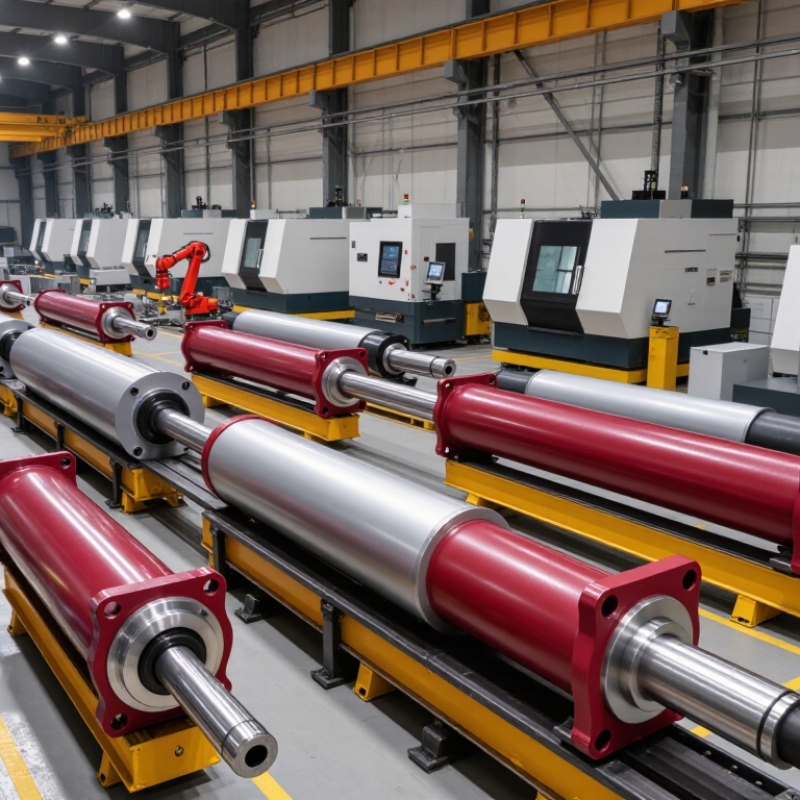
Special hydraulic cylinders are engineered for duties that standard cylinders cannot handle reliably. They may use unusual strokes, compact bodies, corrosion-resistant coatings, high-temperature seals, or integrated position sensing. A mining hoist, ship steering system, steel mill, or mobile crane can demand these changes. In practice, the boundary is not always neat. A cylinder becomes “special” when its environment, load cycle, or installation requires tailored engineering.
Market figures
Market figures show why this niche matters. Grand View Research estimated the global hydraulic cylinder market at more than USD 14 billion in 2023. Its report identifies construction, agriculture, and industrial equipment as major demand areas. ISO 6020/2 and ISO 6022 also provide dimensional and performance frameworks for metric cylinders. These standards help buyers compare designs, but they do not replace application testing. A ten-ton load on paper may behave differently under shock, side loading, heat, and contamination.
Tips: Ask for load charts, cycle-life evidence, seal temperature limits, and test records. Check rod buckling, mounting alignment, oil cleanliness, and emergency stopping behavior. Field experience suggests that many failures begin with misalignment, not weak steel. I would question optimistic service-life claims, too. Real duty cycles are often harsher than drawings suggest. For a top-10 manufacturer review, compare engineering support, traceability, repair access, and documented quality controls, not catalog size alone.
China’s special hydraulic cylinder market deserves technical scrutiny, not only price comparison. Grand View Research estimates the global hydraulic cylinder market at about USD 14 billion in 2023, with steady growth through 2030. This expansion increases supplier choices, but it also increases evaluation risk. A reliable manufacturer should show application experience with mining, marine, construction, or industrial equipment. Ask for drawings, load calculations, fatigue assumptions, and documented design changes.
Factory capability matters. Inspect machining accuracy, welding procedures, heat-treatment records, and sealing assembly areas. Request material certificates and serial-number traceability for every pressure-bearing component. Testing should include pressure holding, leakage inspection, stroke measurement, and, where required, endurance testing. ISO 9001 certification supports process control, but it does not prove cylinder performance by itself. The supplier should also explain compliance with relevant ISO hydraulic-cylinder dimensions and customer safety requirements.
The strongest evidence comes from repeatable records. Review factory acceptance reports, nonconformance rates, corrective actions, and delivery history. Interact Analysis reports continuing investment in industrial automation and hydraulic equipment, making digital quality tracking increasingly important. Still, a polished audit presentation can hide weak field support. Visit the production line when possible. Test one sample independently. Do not accept vague claims about “custom quality.” My own evaluation would score engineering response time, prototype accuracy, spare-parts access, and warranty handling separately. Price remains important, but a cheaper cylinder can become expensive after seal failure, downtime, or redesign.
This procurement framework compares the main factors used when evaluating special hydraulic cylinder suppliers. Product quality and certification receive the highest weighting, followed by engineering customization and pressure or load performance. Testing traceability, delivery capability, and after-sales support should also be verified before selecting a manufacturer.
China Top 10 Special Hydraulic Cylinder Manufacturers?
China’s leading special hydraulic cylinder manufacturers serve demanding fields such as construction, mining, marine equipment, and heavy transport. The first profile represents a factory specializing in oversized cylinders, with deep-bore machining and controlled welding procedures. The second focuses on compact cylinders for automated production lines. Its engineers usually prioritize response speed, sealing stability, and easy maintenance. The third is known for telescopic cylinders used in lifting platforms and transport systems. Space is limited there.
The fourth manufacturer develops corrosion-resistant cylinders for ports and coastal machinery. Protective coatings, stainless components, and pressure testing are central to its production process. The fifth supplies high-load cylinders for metallurgical equipment, where side loads can expose weak designs quickly.
The sixth emphasizes customized hydraulic cylinders for agricultural and forestry machines. Its practical strength lies in adapting mounting dimensions and stroke lengths. The seventh produces servo-hydraulic cylinders for precise industrial movement. Sensors and repeatability receive close attention. The eighth serves waste-handling and recycling equipment, demanding durable rods and contamination-resistant seals.
The ninth manufacturer concentrates on cylinders for tunnel construction and underground machinery. Engineers must consider vibration, dust, and restricted installation spaces. The tenth develops cylinders for specialized lifting and emergency-response equipment, where reliability cannot be treated as a slogan.
Factory audits should examine material certificates, weld records, pressure-test data, and service response. Some product pages promise impressive performance, yet independent verification may be limited. Buyers should request drawings, fatigue assumptions, replacement-seal details, and realistic delivery records. A strong manufacturer is not always the largest one; sometimes, clearer communication prevents the most expensive failure.
China’s Top 10 Special Hydraulic Cylinder Manufacturers: Comparing Technology and Services
A useful comparison starts with engineering depth, not catalogue size. The leading ten suppliers commonly support mining, marine, construction, and heavy forming equipment. Their differences appear in pressure ratings, rod coatings, sealing systems, and fatigue validation. MarketsandMarkets estimates that the global hydraulic cylinder market will continue expanding through 2028, driven by construction automation and industrial equipment demand. That growth rewards suppliers with repeatable testing, not only low prices.
Technology varies sharply. Several manufacturers use finite-element analysis, robotic welding, and computer-controlled honing. Better facilities record bore tolerance, surface roughness, and leakage results for every batch. ISO 6020/2 and ISO 6022 compliance can indicate sound design discipline, although certification alone proves little. It must connect with pressure testing and documented material traceability. Service tells the story. Custom drawings, sample approval, spare-seal availability, and remote troubleshooting separate responsive suppliers from ordinary fabricators. McKinsey reports that predictive maintenance can reduce machine downtime by 30% to 50% in suitable industrial settings. Cylinder suppliers increasingly support this shift with sensors and condition-monitoring interfaces.
Lead time remains difficult to compare. A short quotation period may hide long machining queues. That gap matters. Site experience suggests that commissioning support often prevents more losses than a small purchase discount. Still, published service claims need verification through factory audits, reference projects, and failure records. Some comparisons also overlook repairability, which is a practical weakness. A strong cylinder should be serviceable in a dusty workshop, not only impressive in a laboratory.
| No. | Anonymized Manufacturer Profile | Primary Special-Cylinder Capability | Typical Bore Range | Typical Working Pressure | Specialized Technologies | Customization Capability | Quality and Testing Services | Engineering Support | Export and After-Sales Services | Overall Capability |
|---|---|---|---|---|---|---|---|---|---|---|
| 1 | Manufacturer Profile 01 | Heavy-duty cylinders for metallurgy, mining, offshore equipment, and large industrial machinery | 160–1,200 mm | 250–700 bar | Welded construction Large-bore design Position sensing | High; stroke, mounting, coatings, seals, ports, and sensors can be engineered to specification | Material certificates, dimensional inspection, pressure testing, surface inspection, and functional testing | Application review, load and buckling calculations, 2D/3D drawings, and prototype support | Export packing, technical documentation, spare-seal support, and remote troubleshooting | ★★★★★ |
| 2 | Manufacturer Profile 02 | Custom cylinders for mobile machinery, lifting systems, agricultural equipment, and transport applications | 40–500 mm | 160–350 bar | Tie-rod cylinders Welded cylinders Compact designs | High; mounting styles, rod materials, seal packages, and hydraulic interfaces are configurable | Hydrostatic testing, leakage checks, coating inspection, and batch traceability | Load matching, installation guidance, CAD file exchange, and design-for-manufacture review | Containerized shipment, multilingual documents, replacement parts, and warranty coordination | ★★★★★ |
| 3 | Manufacturer Profile 03 | High-cycle cylinders for injection molding, machine tools, production lines, and automated equipment | 32–320 mm | 140–315 bar | High-cycle sealing Servo-ready options Low-friction guides | High; tolerances, response requirements, sensors, and port configurations can be adapted | Cleanliness control, dimensional reports, pressure testing, cycle testing, and seal verification | Cycle-life analysis, tolerance review, hydraulic schematic review, and commissioning assistance | Application manuals, spare-part lists, remote support, and scheduled maintenance guidance | ★★★★☆ |
| 4 | Manufacturer Profile 04 | Hydraulic cylinders for construction machinery, cranes, excavators, and material-handling systems | 50–600 mm | 180–420 bar | Hard-chrome rods Cushioning Load-holding options | High; stroke, retracted length, clevises, trunnions, and integrated valves can be specified | Pressure testing, weld inspection, coating measurement, dimensional control, and endurance testing | Duty-cycle assessment, mounting alignment review, field replacement guidance, and retrofit support | Export crating, installation instructions, seal kits, and technical response service | ★★★★☆ |
| 5 | Manufacturer Profile 05 | Corrosion-resistant cylinders for marine, coastal, chemical, water-treatment, and outdoor applications | 40–450 mm | 150–350 bar | Stainless components Marine coatings Special seals | Medium to high; materials, coatings, rod treatments, and sealing systems are selectable | Salt-spray evaluation, pressure testing, coating inspection, material verification, and leakage testing | Environment assessment, corrosion-selection advice, mounting review, and maintenance planning | Protective packaging, documentation for offshore use, spare parts, and service recommendations | ★★★★☆ |
| 6 | Manufacturer Profile 06 | Compact and lightweight cylinders for robotics, factory automation, specialized vehicles, and AGV systems | 20–250 mm | 100–250 bar | Compact packaging Integrated sensors Low-friction systems | High; envelope, ports, sensors, rod ends, and mounting details can be optimized | Dimensional inspection, pressure testing, sensor verification, cleanliness checks, and functional testing | Space-constraint analysis, motion review, CAD integration, and prototype iteration | Small-batch logistics, technical files, replacement components, and remote application support | ★★★★☆ |
| 7 | Manufacturer Profile 07 | Telescopic cylinders for dump trucks, refuse vehicles, lifting platforms, and mobile tipping systems | 60–500 mm | 160–300 bar | Multi-stage design Synchronized extension Compact retraction | Medium to high; stage count, stroke, mounting, oil ports, and retracted length can be customized | Extension and retraction testing, pressure testing, leakage inspection, and dimensional verification | Stability review, load-distribution analysis, mounting guidance, and installation support | Rebuild kits, maintenance instructions, protective shipping, and remote diagnostics | ★★★★☆ |
| 8 | Manufacturer Profile 08 | Long-stroke cylinders for presses, steel equipment, shipbuilding machinery, and infrastructure projects | 100–1,000 mm | 200–500 bar | Long-stroke machining Guided rods Heavy-duty seals | High; stroke accuracy, rod diameter, guidance, cushioning, and mounting can be engineered | Full-stroke testing, pressure testing, concentricity checks, weld inspection, and surface measurement | Buckling calculations, alignment review, installation drawings, and project-based engineering | Project documentation, export packing, commissioning advice, and long-term spare-parts planning | ★★★★☆ |
| 9 | Manufacturer Profile 09 | Standardized and semi-custom cylinders for general industrial equipment and replacement applications | 25–400 mm | 100–315 bar | Modular design Interchangeable mounts Short lead-time models | Medium; common dimensions are configurable, while special designs may require engineering review | Pressure testing, dimensional inspection, leakage checks, and production-batch records | Size selection, replacement matching, basic load review, and installation guidance | Fast quotation, standard documentation, spare seals, and distributor-oriented support | ★★★☆☆ |
| 10 | Manufacturer Profile 10 | Economical custom cylinders for agricultural machinery, workshop equipment, trailers, and low-to-medium duty systems | 25–300 mm | 100–250 bar | Cost-optimized design Basic cushioning Common seal systems | Medium; common materials, mounting configurations, strokes, and port sizes can be adapted | Hydrostatic testing, visual inspection, dimensional checks, and basic functional testing | Drawing confirmation, basic sizing support, replacement consultation, and installation advice | Standard export packing, product datasheets, seal replacement guidance, and responsive order support | ★★★☆☆ |
Note: The technical ranges shown are indicative industry comparison values for anonymized Chinese special hydraulic-cylinder manufacturer profiles. Actual specifications, certifications, lead times, and service coverage should be confirmed against the supplier’s current technical documentation and quotation.
Market size alone should not decide your shortlist. Grand View Research estimates the global hydraulic cylinder market will expand steadily through 2030, with construction, agriculture, and industrial equipment driving demand. However, report definitions differ. Numbers can mislead. Your application matters more than market rankings.
Check whether the supplier understands pressure, stroke, mounting space, duty cycle, and operating temperature. Ask for material certificates, dimensional inspection records, weld procedures, and pressure-test results. ISO 9001 certification supports process control, but it does not guarantee perfect cylinders. Request recent records for similar projects. A supplier avoiding evidence deserves caution.
For special cylinders, review piston-rod coating, seal compatibility, surface roughness, and corrosion protection. Confirm compliance with relevant ISO 6020/2, ISO 6022, or customer-specific standards. Independent inspections can verify critical dimensions before shipment. Production capacity also needs proof, not promises: examine machining equipment, testing benches, traceability, and corrective-action procedures. Reports from Mordor Intelligence indicate Asia-Pacific remains a major hydraulic equipment production region, but low labor cost is not equal to stable quality. I have seen technically attractive quotations fail because drawings lacked tolerance details. Leave room for review. A clear inspection plan, pilot sample, and written change-control process reduce that risk.
Join our mailing list to receive the latest news and updates from our team.