How to Choose a Manual Ceramic Coffee Grinder
Choosing a Manual Ceramic Coffee Grinder is less about finding a perfect tool and more about matching its design to your daily brew. A ceramic burr set can resist corrosion and stay sharp through regular use, but ceramic can chip if dropped. That detail matters. A grinder that feels sturdy on a counter may be less reassuring in a packed travel bag.
Coffee educator and author James Hoffmann has emphasized how much grinder choice affects a cup. Put simply, his guidance can be paraphrased this way: “A good grinder is central to good coffee.” That is useful advice, though it does not pick a model for you. Look for steady burr alignment, clear grind adjustments, and a handle that turns smoothly without wobbling. Check whether the catch cup fits your usual dose. Small details count.
Think about your brewing routine. French press needs a coarser setting; pour-over usually calls for finer control. A compact grinder may suit one cup at a time, while a larger chamber saves repeated filling. Cleaning should be simple, too. Coffee dust gathers in corners. It can be annoying.
No choice is flawless. Ceramic burrs may suit quiet, electricity-free brewing, yet grinding can take patience. Compare materials, adjustment range, capacity, and replacement-part access before buying. Then choose for the coffee you actually make, not an imagined routine. That distinction is easy to miss.
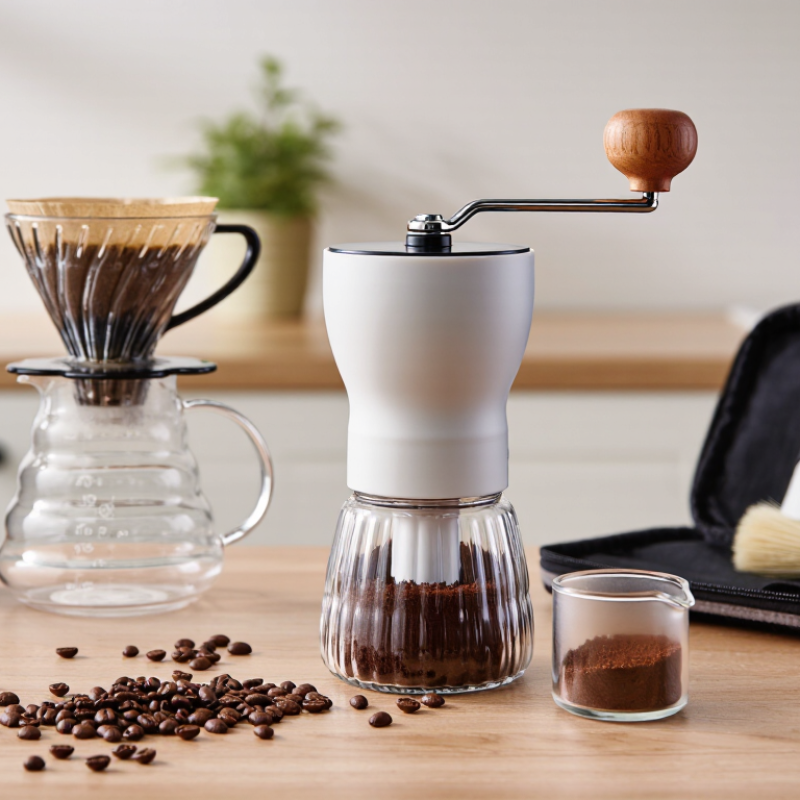
Identify Your Brewing Needs and Preferred Grind Range
Before choosing a manual ceramic coffee grinder, think about how you brew most often. French press usually needs a coarse, unevenly textured grind, while pour-over works better with a more controlled medium range. Espresso requires very fine grounds and often small, precise adjustments. Check that the grinder can reach your preferred setting; a wide range is not useful if its steps skip the texture your brew needs. If you switch between methods, consider how easily you can move from coarse to fine and return to a familiar setting. That detail matters.
Look closely at the adjustment mechanism and how clearly each setting is marked. A numbered dial or distinct clicks can make repeatable brewing easier, though markings alone do not guarantee a good result. For a practical check, grind a small amount and inspect it against your usual brew method: coarse grounds should resemble rough salt, while pour-over grounds are closer to granulated sugar. These are rough comparisons, not exact standards. Taste the cup, then adjust one step at a time. Even a careful choice may need tuning; grind size, coffee freshness, and pouring technique all affect the result. I would not choose by range alone. A grinder that is easy to adjust consistently may suit your daily routine better than one with more settings.
How to Choose a Manual Ceramic Coffee Grinder
Identify your brewing needs and preferred grind range
These approximate grind-size ranges are practical starting points, not universal standards. Choose a grinder with settings suited to your preferred brewing methods, then adjust the grind to taste and recipe.
Compare Burr Design, Adjustment Settings, and Grind Consistency
A manual ceramic coffee grinder should be judged by its burr geometry, not by the word “ceramic” alone. Conical burrs guide beans toward the cutting edges, while flat burrs use parallel faces; in either design, alignment and sharp edges matter. Ceramic can resist corrosion, but it may chip if dropped. A careful hand helps.
Adjustment settings shape daily usability. Look for a clear click or marked range, then test whether one small change produces a noticeable shift in brew time. For pour-over, grind a dose and inspect it under bright light: excessive dust beside large flakes signals uneven output. It is a rough check, not lab testing. The Specialty Coffee Association’s brewing guidance places a typical target extraction yield around 18–22%, but grind size is only one factor; water, dose, and pouring also matter.
Consistency is more useful than a huge number of settings. In a 2016 Scientific Reports study, Hendon and colleagues showed that grind setting and dose interact strongly in espresso extraction, and their optimized method used about 25% less coffee while maintaining comparable beverage targets. That finding is not a universal grinder score. Compare grinders with the same beans, dose, and setting, then record grind time and brew time. Ceramic burrs can run slowly by hand. Slight variation is normal.
Assess Capacity, Build Quality, and Handle Comfort
Capacity affects how often you stop to refill. A grinder holding 20 to 30 grams can suit one cup, while larger batches need more room. Check the usable capacity, not just the seller’s headline figure. Some beans sit loosely above the burrs, and that can make a small chamber feel cramped. Measure your usual dose at home.
Build quality shows up in the parts you touch and adjust. Turn the adjustment ring and check whether it moves evenly, without gritty catches. A stable ceramic burr set should stay aligned during ordinary grinding, though ceramic does not mean indestructible. Avoid dropping the grinder or forcing a jam. Look for a secure lid, a firm axle, and a catch cup that threads on cleanly. Small details matter.
Handle comfort is easy to overlook until the first slow morning. A longer arm can provide leverage, but it may feel awkward in a narrow kitchen. Try the grip if possible. Does the knob turn freely? Can your other hand hold the body without slipping? A smooth handle helps, yet the grinder may still wobble on a slick counter. I once focused too much on appearance; that was not especially useful. Choose the shape that feels steady in your hands.
Check Cleaning Requirements, Portability, and Ease of Use
Cleaning needs can make a grinder pleasant—or frustrating—to own. Check whether the burrs and chamber can be reached without tools. Coffee oils and fine grounds collect in corners, especially after repeated use. A small brush is usually enough for routine cleaning, but some designs need partial disassembly. Read the care instructions before buying; ceramic parts can chip if handled roughly. Avoid assuming every component is washable. Water may leave moisture in narrow spaces, where grounds can cling or stale. Small details matter.
For portability, consider weight, handle shape, and how securely the parts fit together. A grinder that rattles in a bag can scatter grounds, while a detachable handle may be easy to misplace. Check the body’s grip, too. Smooth surfaces can be awkward when your hands are damp or cold. Ease of use depends on more than turning the crank. Look for a stable base, a clear grind adjustment, and a container that is simple to empty. A tight adjustment ring can be annoying. Test the motion if possible, since hand strength and preferred brewing methods differ. I would not choose solely by compact size; a few saved centimeters may not compensate for tiring, uneven grinding.
Compare Price, Warranty, and Long-Term Value
How to Choose a Manual Ceramic Coffee Grinder
Compare Price, Warranty, and Long-Term Value
A manual ceramic coffee grinder’s price is only the starting point. Check what that price includes: a stable handle, clear grind settings, and parts that can be replaced. A crank that wobbles or a dial that slips can make daily grinding frustrating. Small details matter.
Read the warranty before comparing models. Check its length, what parts it covers, and whether normal burr wear is excluded. A long warranty sounds reassuring, but it may not cover the pieces most likely to need replacement. Also check whether spare parts are easy to find. A cheaper grinder can cost more over time if one worn component makes it unusable. Still, paying extra is not always wiser; your brewing habits matter.
Tips: Estimate yearly cost by adding the purchase price and likely replacement parts. Consider how often you grind, too. A grinder used every morning faces more wear than one used occasionally. Keep the receipt and warranty details. Easy to forget. If possible, test the handle’s motion and adjustment dial in person. A little resistance is normal; uneven movement deserves a closer look.