Choosing Non Woven Wet Wipes for global sourcing involves more than comparing unit prices. A wipe may feel soft in a sample but tear during use or dry out after weeks in transit. Small details matter. Fiber composition, fabric weight, texture, absorbency, and lotion loading all affect performance. Buyers should match these features to the intended use, whether the product is designed for personal care, household cleaning, or another clearly defined application. There is no single specification that suits every market.
This guide outlines practical checks for evaluating products and suppliers. Ask for material specifications, product samples, packaging details, and relevant quality documents. Test wipes under realistic conditions: open and reseal the pack, pull several wipes in sequence, and check moisture distribution. Then confirm production capacity, lead times, carton dimensions, and shipping terms before placing a large order. Keep the intended destination in mind, since labeling and product requirements can differ between markets; verify applicable requirements with qualified local resources. A polished sample is useful, but it cannot prove consistent performance across an entire production run. That part is easy to underestimate. Supplier claims deserve careful review, and written specifications help make comparisons clearer. Even then, results may vary by batch or storage conditions. The goal is not to find a perfect wipe on paper. It is to identify a product and supplier whose documented capabilities match your needs, budget, and sourcing plan.
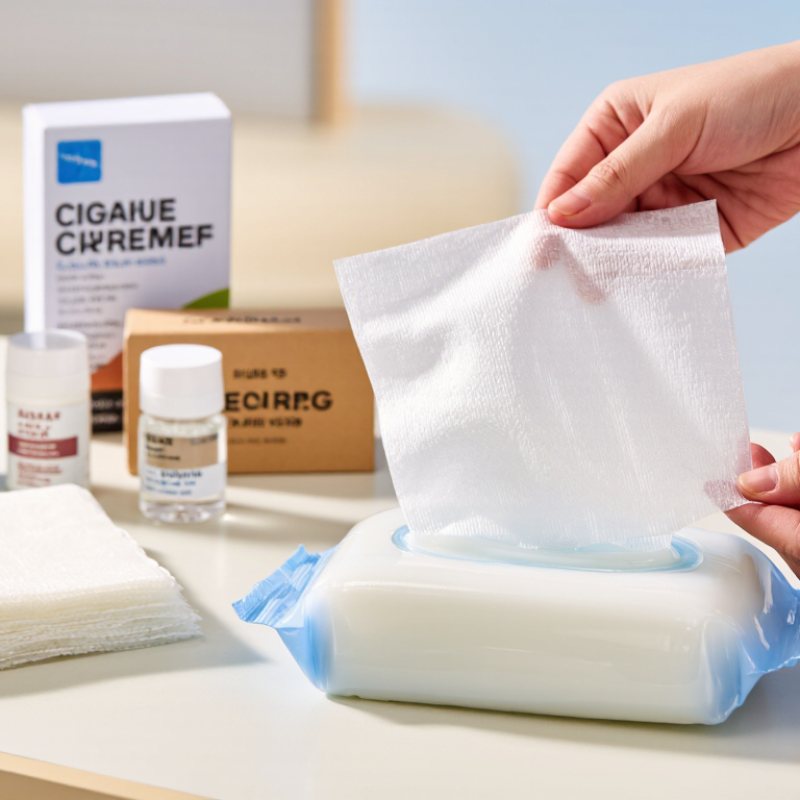
Define the wipe’s job before comparing substrates. A face wipe needs a softer hand feel; a workshop wipe may need stronger wet tensile performance. ISO 9073-1 measures mass per unit area, while ISO 9073-3 measures tensile strength and elongation. ISO 9073-6 assesses absorption. Together, these tests help buyers compare samples using repeatable methods, rather than relying on “thick” or “strong” as subjective claims.
Test the wipe in its intended condition. A dry-web result may not predict performance after lotion is added, so specify the test state and conditioning details with suppliers. Check absorbency alongside wet strength: a wipe that holds liquid but tears during use is not a good trade-off.
EDANA’s 2023 industry statistics reported European nonwoven production at about 2.9 million tonnes, down 5.6% from 2022.
That scale makes consistent specifications useful across sourcing regions, though production volume alone says nothing about a wipe’s suitability. Ask for test reports on the actual substrate, not just a similar grade.
One gap remains: laboratory results cannot fully reproduce a hand wiping a textured surface. Keep a small-use trial in the process. A little inconvenient, perhaps, but worthwhile.
When comparing non-woven wet-wipe samples, record the fiber blend and basis weight together. A 60% viscose and 40% polyester sheet may feel different from a fully viscose sheet, even at the same g/m². Viscose can support softness and liquid uptake; polyester often improves strength when wet. Treat these as tendencies, not guarantees. Fiber length, bonding method, and lotion loading also affect performance.
Use one consistent test method for every supplier. ISO 9073-1 describes how to determine nonwoven mass per unit area; ask for the test conditions and measured results, not only a stated nominal weight. Check at least several sheets from each sample, since small variations can affect converting and pack thickness. A higher basis weight means more material per square metre, but does not automatically mean better cleaning or absorbency.
For sourcing context, Textile Exchange’s Materials Market Report 2024 estimates polyester represented about 57% of global fibre production in 2023. That figure describes the wider fibre market, not wet wipes specifically. Request the supplier’s exact blend, basis-weight tolerance, and wet-strength data. Then compare samples after adding the same lotion quantity and rubbing them over a damp, textured surface. Keep the results. A quick hand-feel check is useful, but it is not a proper test.
When sourcing non woven wet wipes, assess the lotion as carefully as the fabric. If wipes are intended to clean or care for skin, they may fall within the EU Cosmetics Regulation (EC) No 1223/2009. Ask the supplier for the product’s Cosmetic Product Safety Report, prepared by a qualified safety assessor. Check that it covers the finished lotion, intended use, exposure, and target users. A reassuring ingredient list alone is not proof of safety.
Tips: Request the current ingredient list using INCI names, plus fragrance and preservative details. Confirm that a designated EU Responsible Person holds the Product Information File and that the product is notified through the CPNP before EU placement. Keep these records linked to the exact formula and wipe specification. Small changes matter.
Review the label and claims, too. The packaging should provide required cosmetic information, including ingredients and precautions where applicable, in a form consumers can understand. Ask how the manufacturer controls lotion batch consistency and microbial quality, especially after opening. A clean-looking sample is not enough. I would also compare the specification against production samples; suppliers’ documents can be thorough, but real-world checks are easy to overlook. Don’t treat “natural” or “gentle” as evidence of compliance or safety.
EU Cosmetics Regulation (EC) No 1223/2009 requires cosmetic products to be safe. For microbiological quality, EN ISO 17516 provides commonly used limits; the applicable category depends on the product’s intended use.
Category 1: Products for children under 3, the eye area, or mucous membranes. Category 2: Other products. Specified microorganisms must also be absent in the test sample under the standard. These are microbiological criteria, not a universal lotion pH limit; verify the current standard, product classification, and EU safety assessment for each wipe formulation.
For global sourcing, ask for test reports on the finished wipe, not just the preservative blend. ISO 11930 evaluates a cosmetic product’s antimicrobial protection through a controlled challenge test. Under Criterion A, bacteria should fall by at least 3 log units by day 7; yeasts and molds should fall by at least 1 log unit. The test also checks that counts do not rebound during later observations. Small detail, big consequence: a sealed pack may still fail if the lotion formula or fabric affects preservative performance.
Then check routine microbial quality against ISO 17516. For many non-eye-area cosmetic products, its Category 2 limits are 1,000 CFU/g or ml for total aerobic mesophilic microorganisms and 100 CFU/g or ml for yeasts and molds. Specified organisms, including P. aeruginosa, S. aureus, and C. albicans, should be absent in 1 g or 1 ml. Confirm the category with a qualified laboratory; intended use can change the applicable criteria. Ask for methods, sample dates, and batch identification. A passing result from an old pilot batch is not proof for today’s production. I would also compare results from multiple batches, though that adds time and cost. It is easy to overlook. Refer to ISO 11930:2019 and ISO 17516:2014, the published standards defining these test approaches and limits.
How to Choose Non Woven Wet Wipes for Global Sourcing?
Review Packaging and Disposal Labels Under EU Directive 2019/904
When sourcing non woven wet wipes, check the packaging and disposal wording before approving a shipment. EU Directive 2019/904 restricts certain single-use plastic products and sets marking requirements for specific products, including certain wet wipes containing plastic. Applicability depends on the product and market, so verify the current requirements with qualified compliance professionals.
Read the label as a buyer would. Is the disposal instruction visible, legible, and in the required language for the destination market? Does it explain the correct waste route without implying that wipes can be flushed? Inspect the printed artwork on actual packs, not only a supplier’s digital proof. Small text can blur on glossy film. It happens.
Ask suppliers to document fiber composition and provide packaging specifications. “Non woven” describes a material structure, not proof that a wipe is plastic-free or biodegradable. Check claims against technical records, and avoid broad environmental wording that consumers could misunderstand. Even a careful label can leave questions. Review it with local experts before production, and keep approved artwork and test documents tied to each product version.
| Sourcing Dimension | What to Check | Practical Evaluation Data | EU Packaging and Disposal Label Review |
|---|---|---|---|
| Intended use and market category | Confirm whether the wipes are designed for personal care or domestic use, and document their intended users and use instructions. | Record product type, intended use, wipe count, sheet dimensions, and target countries for each SKU. | EU Directive 2019/904 covers certain single-use plastic products, including wet wipes for personal care and domestic use that contain plastic. Confirm applicability for the specific product. |
| Nonwoven composition | Obtain a material declaration identifying each fibre and its percentage by weight. | Example specification: 70% viscose and 30% polypropylene by weight. Treat this as an illustrative data point, not a universal product formula. | Do not describe a wipe as plastic-free unless its composition and supporting evidence substantiate the claim. Natural-origin fibres such as viscose do not, by themselves, establish that the finished wipe contains no plastic. |
| Plastic presence and evidence | Request signed composition declarations, bill-of-material records, and supporting test or supplier documentation. | Check the wipe substrate, binders, coatings, packaging films, and closures separately; identify the material and evidence for each component. | For covered wet wipes, the harmonized marking requirements are set out in Commission Implementing Regulation (EU) 2020/2151. Confirm that the required marking is used where applicable. |
| Harmonized on-pack marking | Review the artwork against the applicable wet-wipe marking design and technical requirements before printing. | Keep an approved artwork file and a version record for each market and packaging format. | The marking informs consumers about plastic content and the environmental harm associated with littering or incorrect disposal. Do not substitute a generic disposal icon for a required harmonized marking. |
| Language and market coverage | Check the languages and consumer-information requirements for every country where the product will be sold. | Maintain a country-by-country artwork matrix, including language versions, label placement, and approval status. | Verify applicable national implementation and language expectations with the importer or local compliance adviser; avoid assuming one language version is suitable for all EU markets. |
| Disposal instructions | Ensure consumer guidance is clear and consistent with the product, packaging, and local waste systems. | Use instructions that distinguish the wipe from the empty package where needed, and check that claims are supported. | Do not imply that a wipe is suitable for flushing unless that claim is appropriately substantiated and permitted. The EU single-use-plastics marking does not replace local disposal guidance. |
| Pack format and label visibility | Assess the label on the actual retail pack, including flexible packs, tubs, and multipacks. | Check legibility, contrast, print durability, and visibility after sealing, folding, or application of an outer label. | Confirm the harmonized marking remains visible and follows the applicable technical specifications in Implementing Regulation (EU) 2020/2151. |
| Supplier documentation | Request current technical data sheets, material declarations, artwork proofs, and change-notification procedures. | Store documents by SKU, production site, revision date, and destination market; recheck them after any material or artwork change. | Keep evidence linking the composition assessment to the compliance decision and final packaging artwork. |
| Import and quality controls | Include substrate identity, wipe dimensions, count, seal integrity, and label checks in the inspection plan. | Set acceptance criteria before production and retain batch records and approved samples. | Inspect production packaging against the approved market-specific artwork, rather than relying only on a supplier’s general compliance statement. |
| Claim and risk review | Review environmental, biodegradability, compostability, and flushability claims separately from regulatory marking. | Require claim-specific evidence and check that wording matches the product tested and the intended disposal conditions. | A claim does not replace mandatory marking or establish compliance with Directive 2019/904. Avoid broad environmental claims that cannot be substantiated. |
Join our mailing list to receive the latest news and updates from our team.