How to Choose the Best Dorayaki Machine for Your Business
Choosing a dorayaki machine is a practical business decision, not just an equipment purchase. The right model should suit your menu, daily order volume, workspace, and staff experience. A machine that performs well in a showroom may behave differently during a busy morning. Batter thickness, room temperature, and repeated heating can all affect the finished cakes.
Small differences matter. Uneven browning can make a batch look inconsistent, while slow recovery between cycles may delay orders. Before choosing, consider plate size, temperature control, production capacity, power needs, and cleaning requirements. Check whether the machine can handle your own batter recipe. If possible, test a sample batch. Look for evenly cooked surfaces, reliable release, and repeatable cooking times. A crisp edge is not always a good sign.
Price alone tells you little. Compare the purchase cost with expected output, maintenance needs, replacement parts, and the supplier’s service support. Ask about warranty coverage and routine care, then verify important specifications directly with the manufacturer or seller. No brochure can answer everything. Even careful estimates can be wrong when demand changes. This guide explains how to assess machine types, key features, operating costs, and supplier questions. Its aim is to help you choose equipment that fits your real workflow, rather than an idealized one. A sensible choice should produce consistent dorayaki and remain manageable for the people using it every day.
Define Production Needs: Match Rated Dorayaki Output to Peak Demand
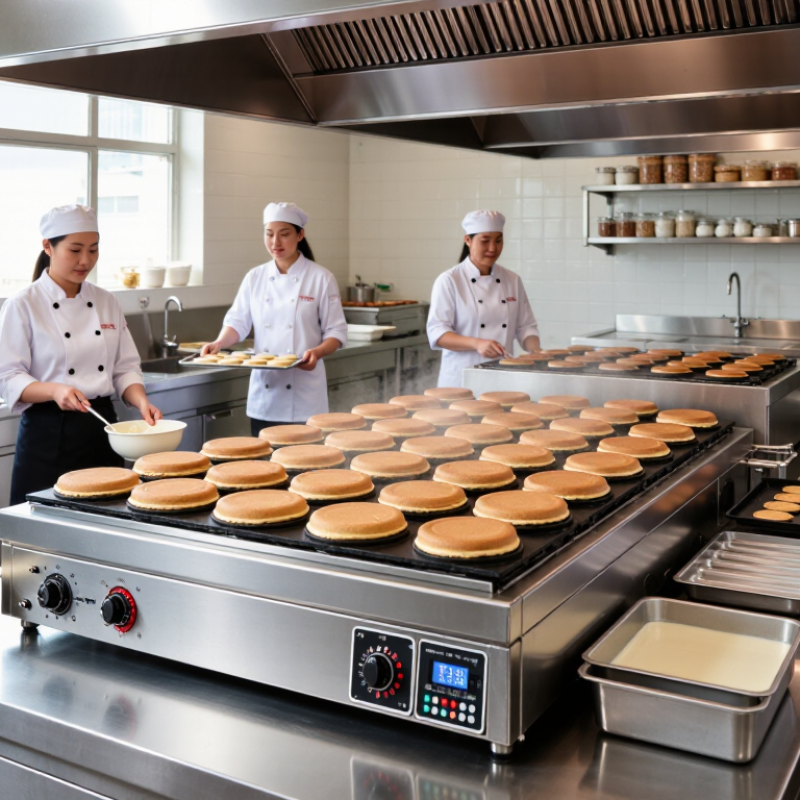
The rated output on a dorayaki machine is a starting point, not a daily promise. Check whether the figure means shells, finished pairs, or cycles per hour; these are not interchangeable. During a busy shift, batter refills, staff handoffs, and brief cleaning pauses reduce usable capacity. Small pauses add up.
Estimate your peak demand by hour, not by average day. If orders rise to 240 finished dorayaki in one hour, and each unit needs two shells, plan for at least 480 shells in that hour. Then add a practical buffer for rejected pieces and downtime. A 15–25 percent margin may suit some shops, but test it against your menu and staffing. Do not buy solely for a supplier’s maximum figure.
Ask for a timed demonstration using your batter, target size, and normal operators. Record acceptable finished pieces over 30 minutes, then check temperature recovery and consistency across several batches. Look for pale centers, uneven edges, or shells that stick after repeated cycles. Those details matter. Rated speed can look impressive on paper, yet miss your actual bottleneck. The estimate may still be off; weekend demand changes, and one slow refill can upset the count. Leave room to adjust.
How to Choose the Best Dorayaki Machine for Your Business — Define Production Needs: Match Rated Dorayaki Output to Peak Demand
Compare the machine’s rated output of complete dorayaki (two pancakes joined with filling) with the hourly output needed during your busiest production window.
| Business scenario | Daily demand
(dorayaki) | Share produced
at peak | Peak window
(hours) | Peak demand
(per hour) | Target rating with
30% headroom | Minimum rated output to consider |
| Small café | 120 | 35% | 2 | 21 | 28 | At least 30 complete units/hour |
| Neighborhood bakery | 600 | 30% | 3 | 60 | 78 | At least 80 complete units/hour |
| High-volume bakery | 2,000 | 40% | 4 | 200 | 260 | At least 260 complete units/hour |
| Seasonal event production | 500 | 60% | 2 | 150 | 195 | At least 200 complete units/hour |
Calculation: Peak hourly demand = daily demand × peak share ÷ peak-window hours. Target rating = peak hourly demand × 1.30, rounded up. Scenarios are illustrative planning examples, not industry benchmarks. Confirm whether a machine’s published rating counts complete filled dorayaki or individual pancake halves, and check achievable output under your recipe, size, filling, and operating conditions.
Verify Food-Contact Materials Against EU Regulation (EC) No 1935/2004
When choosing a dorayaki machine, check every surface that may touch batter, filling, or finished cakes. EU Regulation (EC) No 1935/2004 sets general requirements for food-contact materials, including that they must not transfer substances in harmful amounts or unacceptably change food’s composition, taste, or smell. A stainless-steel label alone is not enough. Ask for material specifications and supporting compliance documents for the cooking plates, coatings, seals, hoses, and utensils supplied with the machine. Small parts matter.
It is easy to focus on heating speed and overlook a seal near the batter hopper. Request documentation that identifies the materials and covers their intended food types, contact time, temperature, and cleaning conditions. Check that these conditions match your recipes and daily wash routine; evidence for cool, brief contact may not suit hot, repeated use. Keep supplier records with the machine’s model and batch details, and ask how replacement parts are documented. Paperwork matters. So does the pan. If evidence is unclear, seek advice from a qualified food-contact materials specialist before purchase.
Compare Heating Control, Plate Recovery, and Energy Use per 100 Cakes
When comparing dorayaki machines, look beyond the thermostat setting. Stable heating helps produce evenly browned cakes, but the displayed temperature may not match the plate surface. Check several spots with a suitable surface thermometer after preheating. Watch for pale centers or dark edges. Small differences matter when batter portions are consistent.
Plate recovery shows how quickly a machine regains its working temperature after fresh batter is added. Test it during a realistic run: make a batch, reload the plates, and record the recovery time and the next cakes’ color. A slow recovery can interrupt service; an aggressive setting may brown the outside before the center cooks. Keep batter temperature and portion size steady. Otherwise, the comparison is not fair.
Energy use per 100 cakes is useful only when the test conditions are recorded. Use a plug-in energy meter where appropriate, and include preheating, idle time, and cooking. Compare machines using the same cake size, batch rhythm, and target doneness. The result is a practical operating figure, not a universal promise. It can be a little messy; real shifts rarely follow a perfect test schedule. Still, repeat the measurement on a busy day and a quiet one. That difference may change your buying decision.
How to Choose the Best Dorayaki Machine for Your Business
Compare heating control, plate recovery, and energy use per 100 cakes
Lower values indicate less temperature fluctuation, faster plate recovery, or lower energy use. The figures are illustrative comparison values, not manufacturer specifications; actual results depend on batter, batch size, ambient conditions, and operating settings. Compare machines using the same test procedure.
Assess TCS Filling Safety: FDA Cooling from 135°F to 70°F in 2 Hours
How to Choose the Best Dorayaki Machine for Your Business
A dorayaki machine controls shell size and filling portions, but it cannot make unsafe filling safe. If your filling contains ingredients that require time and temperature control, plan cooling before loading the machine. FDA Food Code guidance calls for cooling from 135°F to 70°F within two hours, then to 41°F within four more hours. Check local requirements, since adopted rules may differ. A probe thermometer and written time log help verify each batch, not just the first one.
Choose equipment with accessible, smooth food-contact surfaces and parts that can be removed for cleaning. Check whether the hopper keeps filling at a safe temperature during service; a covered hopper alone does not provide cooling. Test portion consistency with a chilled custard or bean filling, and watch for slow dispensing or warm spots. Small details matter. I would also leave room to improve the workflow after a real production run. A machine can look efficient on paper and still create queues at the cooling station.
Tips: Divide hot filling into shallow pans, label the cooling start time, and use an ice bath or suitable rapid-cooling method. Stir safely and measure the center with a sanitized probe. Never rely on touch. If a batch misses a required cooling limit, follow your food-safety procedure rather than guessing.
Calculate Total Cost: Labor, Energy, Maintenance, and Payback Period
Before comparing sticker prices, model a dorayaki machine across a normal week. The U.S. Bureau of Labor Statistics reported a median hourly wage of $15.35 for food preparation workers in May 2023. Use your local wage and add payroll costs; the national figure is only a starting point. If a machine saves 45 minutes per shift over 300 shifts, that equals 225 labor hours yearly. At a loaded labor cost of $19 per hour, potential savings reach $4,275. Small shifts matter.
Energy costs can be less obvious. The U.S. EPA’s ENERGY STAR restaurant guidance says restaurants use roughly five to seven times more energy per square foot than other commercial buildings. Track the machine’s actual heating cycles and operating hours, then multiply kilowatt-hours by your utility rate. Measure before buying. Include cleaning supplies, preventive service, replacement parts, and downtime. A weekly log beats a brochure estimate, though it may miss peak-season demand.
Calculate payback by dividing the installed cost by annual net savings: labor and energy savings, minus added maintenance and other costs. For example, a $12,000 installed machine with $4,000 in net annual savings pays back in three years. Compare that period with expected useful life and financing costs. Test output during a busy service, not just an empty-room demonstration; one awkward batter refill can undermine projected labor savings.