
Choosing a Small Travel Motor requires more than matching a nameplate size. The motor must suit the machine’s weight, track width, travel speed, and working environment. A compact excavator on wet clay faces different demands from a tracked carrier on level concrete. Field experience shows that operators often focus on peak torque and overlook heat, oil cleanliness, and continuous duty. That mistake can shorten service life.
A reliable selection begins with verified specifications. Check displacement, rated pressure, maximum pressure, output torque, speed range, and mounting dimensions. Confirm the motor’s compatibility with the hydraulic pump, planetary gearbox, brake, and track assembly. Manufacturer datasheets provide essential limits, but an experienced distributor can explain how those figures behave under real loads. Ask about seal materials, replacement parts, warranty terms, and service support. Small details matter.
Think beyond the first purchase.
Installation space deserves careful measurement. A few millimeters can affect hose routing or brake access. Consider steep slopes, frequent reversing, shock loads, and long travel distances. These conditions may require a stronger motor than basic calculations suggest. However, oversizing is not automatically safer. It can reduce efficiency, increase cost, and strain other components. My own judgment can still be incomplete without the machine’s pressure readings and duty cycle. Recheck the data before ordering. The best Small Travel Motor balances performance, durability, efficiency, and practical maintenance.
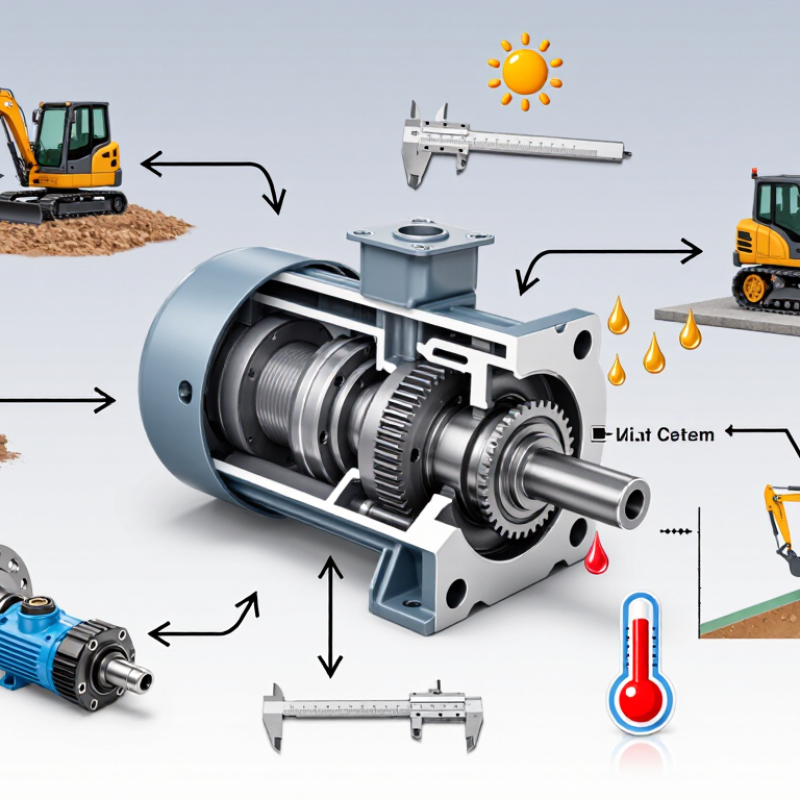
Before choosing a small travel motor, define the machine’s real operating conditions. Record total mass, maximum slope, wheel or sprocket radius, travel speed, duty cycle, and ground resistance. A 2,000 kg machine on compact gravel needs very different torque from the same machine on wet clay. Measure actual conditions when possible. Catalog assumptions are often optimistic.
Use pressure and displacement calculations to check the requirement. Required torque can be estimated with T = Δp × D × ηm ÷ 2π, while flow depends on displacement, speed, and volumetric efficiency. Include starting torque, not only running torque. A motor that moves smoothly may still stall against a curb. The 2023 Off-Highway Research market report recorded roughly one million construction equipment units sold globally, showing how widely compact travel systems are used. However, market volume cannot replace site measurements. This is where many selections go wrong.
Check continuous pressure, peak pressure, thermal load, and contamination control. ISO 4406:2021 defines hydraulic-fluid cleanliness using a three-number particle code, so filtration should match the motor and valve requirements. Compare the calculated flow with the pump’s measured output, especially at low engine speed. Leave practical reserve, but avoid excessive oversizing; it can reduce control accuracy and increase heat. I would also test the motor on the steepest route, because laboratory results rarely capture loose soil, cold oil, or uneven loading.
The chart estimates the continuous tractive force required for a 2,000 kg tracked machine under different operating conditions. The calculation uses F = m × g × (rolling resistance + grade), with a 20% engineering allowance for load variation and drivetrain losses.
Select a travel motor whose continuous tractive force exceeds the highest expected operating requirement. Check starting torque, travel speed, sprocket radius, duty cycle, hydraulic flow, and allowable motor pressure before final sizing.
Choosing a small travel motor starts with the machine’s real working conditions, not its catalog size. Axial-piston motors suit higher pressure and demanding travel loads. Orbital motors are often simpler and useful for lighter, slower applications. Radial-piston designs can deliver strong starting torque, but may add weight and cost. Compare each type with duty cycles, ground slope, and available hydraulic flow. A compact motor can still be wrong. I have seen undersized units overheat during repeated turning.
Torque depends mainly on displacement and pressure. Larger displacement usually creates more torque per revolution, but it reduces maximum speed at the same flow. Smaller displacement gives higher speed, though starting force may suffer. Estimate torque from pressure, displacement, and mechanical efficiency. Never use theoretical figures alone. For speed, check rated flow, maximum continuous rpm, and peak rpm. Peak speed is not a normal operating target. Also verify case-drain limits and allowable pressure spikes.
Tips: Measure actual flow with the machine warm. Compare continuous torque, not only peak torque. Leave a safety margin for slopes, mud, and sudden resistance. Confirm mounting dimensions and shaft capacity before ordering. Read test conditions carefully; ratings can look better than field results. My earlier selections sometimes focused too heavily on speed. Real jobs often reward controlled torque and cooler operation.
Choosing a small travel motor starts with size, not appearance. Measure the available width, length, shaft position, and service clearance. A compact motor still needs room for hoses and maintenance tools. Grand View Research valued the global hydraulic equipment market at about USD 45.2 billion in 2022. This growth reflects demand for smaller, efficient mobile systems. However, market growth does not guarantee a correct fit. Measure twice. A motor with excessive displacement may move slowly or overload the drive system.
Mounting accuracy matters just as much. Match the flange, bolt pattern, shaft type, and pilot diameter before ordering. Even a small mismatch can create vibration and seal damage. Hydraulic compatibility requires checking rated pressure, peak pressure, flow, rotation, and fluid type. The MarketsandMarkets 2023 study estimated the mobile hydraulics market could reach roughly USD 19 billion by 2028, with compact equipment contributing to expansion. That projection is useful, but operating data matters more than forecasts. Confirm circuit cleanliness against ISO 4406 guidance, then compare the motor’s actual duty cycle with its rating.
Control options also deserve practical attention. A fixed-displacement motor suits simple travel functions, while variable control supports smoother speed changes. Proportional valves can improve low-speed handling, but they add cost and tuning work. I have seen selections fail because control response was ignored. Keep it practical. Recheck the motor under cold-start conditions, restricted flow, and uneven ground.
When choosing a small travel motor, check efficiency under real working conditions. Do not rely only on the peak efficiency figure. Compare displacement, operating pressure, speed range, and expected load. A motor that runs smoothly at low speed can improve control on slopes and narrow paths. Measure heat after continuous operation. Excessive temperature often reveals poor matching or restricted oil flow.
Durability depends on more than housing thickness. Inspect the shaft seal, bearing arrangement, gear materials, and corrosion protection. Ask for rated life, pressure limits, and duty-cycle data. In field inspections, loose track tension often causes unnecessary motor stress. Correct alignment matters too. It is easy to overlook.
Maintenance should be simple and safe. Choose accessible drain ports, clear oil-level guidance, and replaceable seals. Check whether routine inspection requires removing heavy covers. That design can waste time and increase injury risk. Safety features deserve close attention. A reliable travel motor may include a holding brake, overload protection, pressure relief, and controlled start-up. Confirm that the brake engages during power loss. Also verify compatibility with the machine’s hydraulic circuit and emergency controls.
Higher efficiency can still mislead. A motor may perform well in laboratory tests but struggle with muddy ground, cold oil, or repeated reversing. Request test conditions and service records where possible. Leave room for doubt, and inspect the actual machine before buying.
Select the Best Motor by Matching Performance, Cost, and Application Needs
A small travel motor should fit the machine, not merely the available space. Check required speed, torque, pressure, displacement, and duty cycle. A compact excavator may need strong starting torque on wet soil. A warehouse vehicle may value smooth low-speed movement instead.
Measure the real load, including slopes, attachments, and repeated starts. A motor that looks efficient on paper can overheat during daily work.
Cost includes more than the purchase price. Compare energy use, hose requirements, controls, maintenance access, and expected service life. Review certified test data and installation limits from reliable technical documents.
In field evaluations, I also inspect noise, leakage risk, response time, and bearing temperature. My first estimate was too optimistic once; short operating tests revealed heat buildup.
That mistake changed my selection process. I now test near the hardest normal condition, not only in a clean workshop.
Tips: Create a simple performance table before buying. Leave a modest torque margin, but avoid excessive oversizing. Ask whether replacement parts are available locally. Record pressure and temperature during a trial. Recheck the choice with an experienced technician. Small details matter.
Join our mailing list to receive the latest news and updates from our team.