
Choosing an Industrial Drone is less about buying the most impressive aircraft and more about matching equipment to the worksite. A multirotor inspecting a flare stack faces different demands from a fixed-wing drone surveying a long pipeline. Payload, flight time, wind tolerance, camera quality, and data workflow all affect the result. A low purchase price can look attractive until batteries, training, repairs, and software are added.
PwC’s 2016 report, Clarity from Above, estimated that drone-powered solutions could address $127.3 billion in labor and service costs across several industries. This is an estimate of potential value, not a promise of savings for every buyer. The distinction matters. Former FAA Administrator Michael Huerta described the broader shift this way: “We are at the beginning of a new era in aviation.” For global buyers, that era still requires practical evaluation: check local operating requirements, supplier support, parts availability, and data-security arrangements before placing an order.
A useful shortlist starts with a real mission. Can the drone carry the required sensor and complete the route with reserve battery power? Will the supplier provide repair support where the aircraft will operate? Ask for a demonstration using representative site conditions, not a perfect showroom flight. Details matter. Specifications can mislead, and even an experienced buyer may overlook the cost of keeping a fleet ready. The tips ahead focus on those trade-offs, helping buyers compare capability, service, and total ownership cost with fewer assumptions.
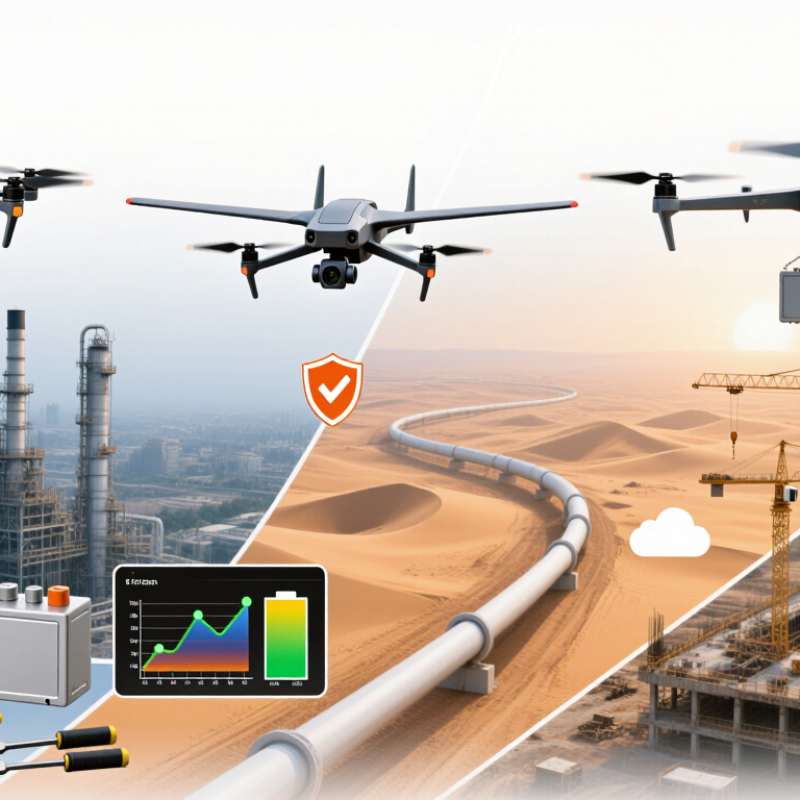
An industrial drone should match a defined job, not a brochure’s maximum range. Map the route, payload, image detail, and daily flight hours before comparing aircraft.
A 2016 Clarity from Above industry report estimated $127.3 billion in potential value across drone-enabled business applications.
Treat that figure as market context, not proof that a particular aircraft suits your site. A roof inspection needs stable close-range imaging; a large outdoor survey may need longer endurance and reliable positioning. Small details matter.
Record real operating conditions, not just typical weather. Note peak wind, rain exposure, dust, temperature, elevation, and radio-signal obstructions. A loaded drone may lose flight time, especially in cold weather or gusts.
Check battery swap time and whether landing areas are safe and accessible. Test the intended payload on a representative route. A common weak spot is planning around an ideal day.
I would leave that assumption open to challenge: repeat the test with realistic wind, full payload, and the actual site layout.
Include the operator’s workload, too; frequent manual corrections can make a technically capable aircraft impractical.
Multirotors can hover beside a tower, bridge, or conveyor, making them useful for close inspections. Their trade-off is limited flight time, especially with heavier cameras or sensors. Fixed-wing aircraft cover larger areas efficiently but need room to launch and land. Hybrid vertical-takeoff designs combine both approaches, though added mechanics can mean more maintenance. Match the aircraft to the site, not just the brochure.
PwC’s 2016 Clarity from Above report estimated $127.3 billion in potential business value from drone-powered solutions across industries; that figure is an estimate, not today’s market size.
Payload figures need careful reading. A stated maximum may include the aircraft’s own equipment, while usable payload means the sensor or tool you can actually carry. Payload numbers mislead. Ask for flight-time figures with your intended load, then test them in representative wind and temperature.
The FAA’s 2023 Aerospace Forecast projected the U.S. commercial small-drone fleet could reach 1.18 million by 2027, signaling a growing range of operating needs.
Range is not endurance. Check battery swaps, data links, wind limits, and the time needed to inspect one full worksite. A drone that carries a thermal camera but cannot finish a shift may cost more in delays. Test it loaded. Some details are easy to miss. A short field trial often exposes them.
Before paying for an industrial drone, ask for current safety documents covering the exact aircraft, battery, controller, and payload configuration. Do not rely on a brochure. Request test reports, conformity declarations, and maintenance intervals, then confirm they match the model and its intended working conditions. A certificate for one configuration may not cover a heavier camera or modified battery. That detail matters. Check radio equipment approvals and battery transport requirements with the relevant authorities and carriers in each destination.
Local rules vary by country and sometimes by city, site, or airspace. Confirm pilot qualifications, registration, operating limits, insurance, and permission requirements before arranging delivery or training. For factory inspection, clarify whether indoor flight is treated differently from outdoor work. Ask whether the site requires its own risk assessment. Keep written answers, dates, and contact names with the procurement file. Rules can change. A spreadsheet helps, but it cannot replace checking official sources; even careful teams sometimes miss a local notice. Recheck requirements shortly before deployment.
A capable industrial drone supplier should provide evidence, not just confident promises. Review its manufacturing history, quality procedures, and references from customers using similar payloads and operating conditions. Ask for sample inspection records, serial-number traceability, and acceptance-test criteria. Request a clear explanation of how defects are logged and resolved. Vague answers deserve a pause. A polished brochure proves little.
Training should cover both flight operations and routine maintenance. Check whether instruction includes battery inspection, sensor calibration, mission setup, emergency procedures, and safe handling of equipment. Ask who teaches each course and how trainee competence is assessed. A signed attendance sheet is not proof of readiness. Practical exercises matter: can staff spot a damaged propeller or follow a failed-link procedure? Training plans may look complete on paper, yet overlook the weather and terrain at the actual worksite.
After-sales support can determine whether a drone returns to service quickly or sits idle. Confirm support hours, repair locations, spare-part availability, and realistic shipping times. Clarify warranty exclusions, software update responsibilities, and escalation steps in writing. Ask for an anonymized service case showing the fault, response time, and repair outcome. One detail is easy to miss: a promised part may be available, but not locally. Build a small trial into procurement, and revise expectations when field results contradict the sales schedule.
| # | Buying Tip | What to Assess | Evidence to Request | Practical Decision Check |
|---|---|---|---|---|
| 1 | Verify the supplier’s operating track record | Look for experience with comparable industrial missions, operating environments, and deployment scale. | Redacted case studies, customer references where available, deployment history, and service coverage details. | Confirm that references can discuss reliability, delivery performance, and support after installation. |
| 2 | Check regulatory and export readiness | Requirements vary by country and may cover aircraft registration, pilot qualifications, radio equipment, privacy, and import controls. | Product specifications, available conformity documents, export classification information, and a list of documents supplied for customs and local approvals. | Ask which approvals are the buyer’s responsibility and verify requirements with the relevant local aviation authority before ordering. |
| 3 | Match the aircraft to the mission | Compare payload, sensor compatibility, flight time under load, environmental limits, and required data quality. | Mission-specific test results, payload interface details, sample outputs, and flight-time conditions such as payload and weather. | Evaluate performance in the intended configuration rather than relying on unloaded or ideal-condition figures. |
| 4 | Assess reliability and maintainability | Review inspection intervals, component life limits, fault reporting, repair procedures, and availability of replaceable parts. | Maintenance schedule, troubleshooting documentation, parts list, warranty terms, and any available reliability or service records. | Estimate total operating cost using planned maintenance, consumables, repairs, training, and downtime—not purchase price alone. |
| 5 | Test the complete system before purchase | Evaluate the aircraft together with its ground station, communications link, payload, software, and data workflow. | A demonstration or acceptance-test plan with measurable mission tasks, environmental assumptions, and pass/fail criteria. | Include representative users and verify that collected data can be exported into the buyer’s existing tools and processes. |
| 6 | Confirm cybersecurity and data handling | Understand where flight and payload data are stored, who can access them, how they are transferred, and how updates are managed. | Data-flow description, access-control options, retention and deletion terms, software update process, and relevant security documentation. | Check that data residency, confidentiality, and operational security requirements can be met in the intended country. |
| 7 | Evaluate training for operators and maintainers | Training should reflect the aircraft configuration, local operating rules, mission procedures, emergency actions, and maintenance tasks. | Course outline, instructor qualifications, practical flight hours, assessment method, training language, and refresher options. | Ask whether training is delivered at the deployment location and whether materials remain available after the course. |
| 8 | Define after-sales service levels | Check support hours, response channels, escalation paths, remote diagnostics, repair turnaround, and regional service capability. | Written service-level terms, support contact process, repair workflow, escalation contacts, and details of any local service partners. | Agree on response and repair targets in writing, including how time zones, weekends, and shipping delays are handled. |
| 9 | Secure spare parts and warranty clarity | Review warranty duration and exclusions, battery handling, repair responsibilities, parts lead times, and end-of-life planning. | Warranty document, recommended initial spare-parts list, parts availability statement, battery care guidance, and product lifecycle notice policy. | Identify critical parts and establish a stocking plan that reflects expected usage and cross-border replenishment time. |
| 10 | Use a phased procurement and acceptance plan | Reduce deployment risk by agreeing on delivery milestones, configuration control, acceptance testing, and post-delivery review. | Statement of work, delivery schedule, acceptance criteria, training and handover checklist, and documented change-control process. | Link final acceptance to verified documentation, successful mission tests, user training, and transfer of agreed support materials. |
An industrial drone’s purchase price is only the first line in its cost model. Count batteries, payload integration, operator training, software, insurance, repairs, and replacement parts. Then add travel, data storage, and downtime. These costs accumulate quietly. Compare systems over the same service period, and divide total ownership cost by productive missions—not flight hours alone. A unit that flies longer may still deliver less value if its payload needs frequent calibration or its batteries lose capacity quickly. Ask suppliers for realistic maintenance intervals and battery replacement assumptions. Verify those figures against your own climate, workload, and service access.
PwC’s 2016 report, Clarity from Above, estimated $127.3 billion in potential value from commercial drone applications, including $45.2 billion in infrastructure. These are projected market opportunities, not guaranteed savings or a buyer’s return on investment. Use them as context, then price a specific task: inspection time reduced, fewer site visits, or defects found earlier. Model a normal year and a difficult one. Include bad weather and grounded aircraft. A spreadsheet will still miss some surprises. Keep a reserve for them. Before signing, compare the purchase price with expected lifetime cost, usable flight capacity, and the value of completed work.
Join our mailing list to receive the latest news and updates from our team.