
What Are the Top HDPE Floaters for Global Buyers?

Global buyers comparing Hdpe Floaters need more than a buoyancy claim. They need to know how each product performs in real water, under real loads, and after repeated handling. A floater that looks sturdy in a catalog may behave differently when exposed to sunlight, changing water levels, or a rough dock edge.

The strongest options usually pair suitable HDPE resin with consistent wall thickness, secure fittings, and a design matched to its intended use. Ask suppliers for dimensions, load guidance, UV-stability details, and inspection information. Check how the floats connect, too. A loose fastener can matter more than a polished product photo. Details add up. No single model suits every project, and buyers should compare specifications rather than rely on broad claims.

A verified industry quotation would add useful perspective here. The supplied material does not identify an expert or provide a source, so inventing a name or quotation would be misleading. Editorial placeholder: “[Verified expert name]: ‘[Confirmed quotation about selecting HDPE floaters].’” Replace it only after confirming the person’s expertise and exact words. That extra check is worth the effort. Even a careful comparison can miss a site-specific issue, such as wave exposure or uneven loading. This guide examines the practical differences buyers can verify before choosing Hdpe Floaters for global projects.
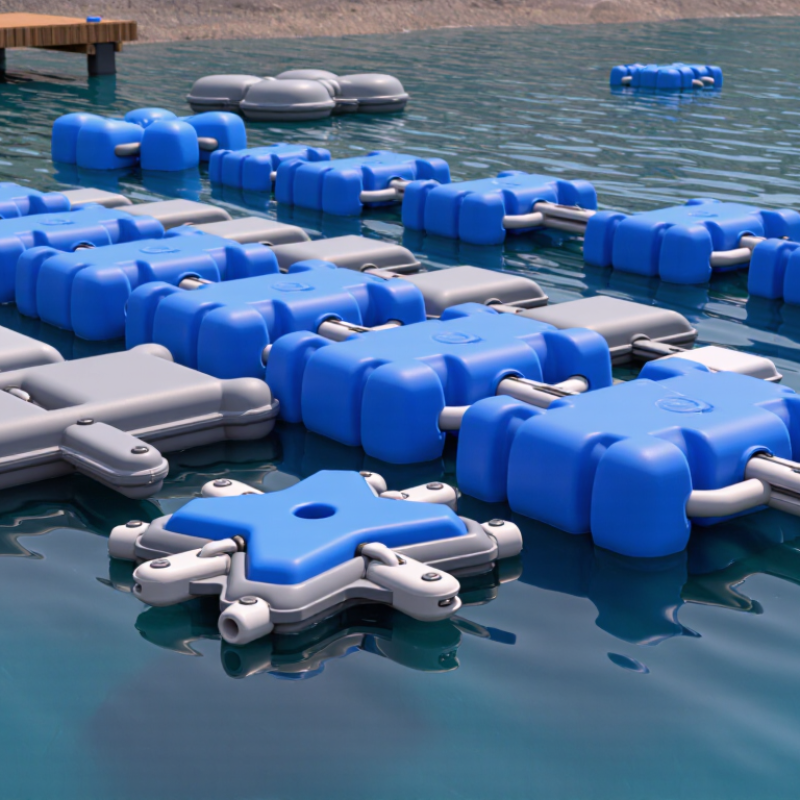
What Are the Top HDPE Floaters for Global Buyers?

HDPE Floater Types: Rotomolded, Pipe-Based, and Modular Designs

HDPE floaters are not one standard product. Their construction affects buoyancy, handling, maintenance, and suitability for different water conditions. Rotomolded floaters have a molded shell with few seams, which can reduce potential leak points. Check wall thickness, UV resistance, and the specified load rather than judging by appearance alone. A sample section can reveal whether fittings feel secure and edges are properly finished.

Pipe-based designs use sealed HDPE pipe as the buoyant body, often with frames or brackets holding the assembly together. They can suit long, straight layouts, such as floating walkways or service platforms. Ask how end caps are sealed and how joints handle repeated movement. Fit matters. A small gap around a clamp can become a noisy wear point when waves keep the structure moving.

Modular floaters connect smaller units into a larger platform, making transport and layout changes easier. Their connectors need close attention: inspect locking parts, pin materials, and replacement availability before ordering. A modular layout may also flex more than expected under uneven loads. Not always. Compare rated capacity with the actual equipment, people, and wave exposure, then allow a practical safety margin. One detail buyers sometimes overlook is access for inspection beneath the platform; cleaning and checking connections should not require dismantling the whole structure.

Material Basics: HDPE Density of 0.941–0.965 g/cm³

HDPE floaters start with a useful material fact: density commonly falls between 0.941 and 0.965 g/cm³. The Plastics Pipe Institute’s Handbook of Polyethylene Pipe provides technical data on polyethylene grades, while ASTM D1505 describes a standard density-testing method. Seawater averages about 1.025 g/cm³, according to NOAA’s National Ocean Service, though local conditions vary. A cubic metre of solid HDPE therefore has roughly 60–84 kg of theoretical buoyancy reserve before accounting for loads or design allowances. A helpful margin. But density alone cannot predict carrying capacity.

Usable buoyancy also depends on displaced volume, wall thickness, joint quality, and the floater’s shape. For example, a hollow unit can carry more payload than a solid block with the same outer dimensions, but a damaged seam may compromise performance. NOAA notes that seawater density changes with temperature and salinity, so field conditions matter. Buyers should request density test records, dimensions, rated load, and immersion-test conditions for a fair comparison. One detail is easy to miss: a published density figure may describe the raw resin, not the finished floater.

What Are the Top HDPE Floaters for Global Buyers? - Material Basics: HDPE Density of 0.941–0.965 g/cm³

Floater type Typical application Common form and indicative dimensions Material density Key buyer checks Practical considerations
Rotomolded pontoon float Floating docks, work platforms, and small modular pontoons Hollow molded body; often about 0.5–2.0 m long, with section dimensions selected for the platform design HDPE resin: 0.941–0.965 g/cm³ Displacement, payload margin, wall uniformity, UV stabilization, and attachment points Confirm usable buoyancy after accounting for the float’s own mass, fittings, and safety reserve.
Pipeline support float Supporting above-water or partially submerged pipelines Usually a split shell or paired float sized to fit the pipe’s outside diameter HDPE resin: 0.941–0.965 g/cm³ Pipe outside-diameter fit, clamp arrangement, net buoyancy, and resistance to impact and abrasion Float spacing and capacity depend on pipe weight, contents, span, and operating conditions.
Dredging pipeline float Floating dredge discharge lines and slurry pipelines Large hollow float or split casing; dimensions are matched to pipeline size and required support HDPE resin: 0.941–0.965 g/cm³ Buoyancy per unit, fastening strength, sealing, wear resistance, and replacement availability Assess the loaded line, including pipe, slurry, couplings, and changing water conditions.
Aquaculture cage float Fish-farm cage collars, walkways, and net-support structures Closed or hollow molded components, often assembled into circular or polygonal collars HDPE resin: 0.941–0.965 g/cm³ Structural stiffness, joint design, UV resistance, net loads, and marine-growth maintenance System performance depends on the assembled collar, mooring, net, and site exposure—not floats alone.
Utility or marker float Mooring lines, boundary marking, and general marine utility use Compact hollow sphere, cylinder, or molded body; size varies with line and visibility requirements HDPE resin: 0.941–0.965 g/cm³ Eye or fitting strength, buoyancy, color visibility, UV package, and impact resistance Specify the intended line load and environment; a marker float is not automatically a lifting device.

Notes: Dimensions are indicative configuration descriptions, not fixed industry standards. HDPE resin density is not the same as a finished hollow float’s overall density. Buoyancy depends on external displaced volume, float mass, payload, and water density; freshwater is approximately 1.0 g/cm³ and seawater is typically about 1.02–1.03 g/cm³.

Buoyancy Ratings: Compare Freshwater at 1.000 and Seawater at 1.025 g/cm³

For HDPE floaters, buoyancy depends on displaced water, not the plastic’s appearance. IAPWS-95 data place pure water near 1,000 kg/m³ around 4°C; seawater near standard ocean salinity is commonly approximated at 1,025 kg/m³. UNESCO’s EOS-80 seawater equation also shows why salinity and temperature matter: seawater density is not a universal constant. These figures match the practical comparison of 1.000 and 1.025 g/cm³, but they are reference values, not every site’s exact conditions.

A sealed floater displacing 1 m³ can support about 1,000 kg of displaced freshwater, or about 1,025 kg in seawater, before subtracting its own mass. The saltwater advantage is roughly 25 kg per cubic metre. Small difference. Real consequences. Buyers should compare net buoyancy ratings, required freeboard, and the floater’s actual submerged volume—not just a headline capacity. Check shell thickness, welded seams, attachment loads, and expected temperature and UV exposure. A float rated for calm water may lose useful reserve when waves repeatedly load its joints. That detail is easy to miss. Also, freshwater near freezing is denser than freshwater around 4°C, so field conditions can shift calculations slightly. Density helps narrow the choice; it does not replace a site-specific load assessment.

What Are the Top HDPE Floaters for Global Buyers?

Buoyancy Ratings: Freshwater at 1.000 and Seawater at 1.025 kg/L

Gross buoyancy is the mass of water displaced, shown here as a kilogram-equivalent. At the same displaced volume, seawater provides about 2.5% more gross buoyancy than freshwater. These figures do not subtract the floater’s own weight or account for payload; actual capacity depends on floater design and operating conditions.

Buyer Checks: Verify Density Testing to ASTM D792 or ISO 1183

When comparing HDPE floaters, ask for a density test report, not just a catalog figure. ASTM D792 and ISO 1183 describe methods for measuring plastic density, but the result is useful only when the tested sample matches the supplied material. Check the test date, specimen identification, units, and method used. Was the sample taken from the finished floater or a separate resin batch? That distinction matters. Small differences matter.

A clear report should state whether density is given in g/cm³ or kg/m³ and explain any sample conditioning. Ask the supplier to clarify unusual results rather than treating one number as proof of quality. A lab report can still leave questions. Density alone does not show how much load a hollow floater can support; dimensions, wall thickness, sealing, and construction also affect buoyancy. For a practical comparison, request consistent test conditions across suppliers, then check the figures against the product’s stated dimensions and intended load. It is easy to focus on a precise decimal and miss a larger uncertainty: whether the tested specimen represents the floaters you will receive.

Global Comparison: Rank Floaters by Payload, UV Resistance, and Shipping Volume

For global buyers, the best HDPE floater depends on the job, not just its advertised capacity. By payload, large, thick-walled modules usually rank highest, followed by medium units and compact floats. Check rated load per unit and per assembled platform.

Connector strength, wave exposure, and uneven loading can change real-world performance. Ratings are not interchangeable.

For UV resistance, prioritize documented UV-stabilized material and ask how testing was performed. Color alone proves little. Strong sunlight can fade surfaces and gradually weaken plastic, especially after years outdoors.

Shipping volume favors compact, stackable shapes when their design allows it; bulky sealed floats may take more container space. Compare packed dimensions, units per pallet, and total freight cost—not product weight alone. Small details matter.

Tips: Request payload figures, UV test details, and a packing diagram before comparing quotes. Ask whether floats can be nested without damaging connectors. A neat spreadsheet helps. Still, supplier figures may use different test conditions, so rankings can be imperfect. Check samples or installation records where practical.

Article Source:

Subscribe To Our Newsletter

Join our mailing list to receive the latest news and updates from our team.

You have Successfully Subscribed!