What Is a 3/8 Tube Hairpin Bender?
A 3/8" Tube Hairpin Bender forms straight copper tubing into compact U-shaped returns, often called hairpins, for heat-exchanger coils. The tool controls the bend around a defined radius while helping limit flattening, kinks, and unwanted movement. In practice, the operator aligns the tube, sets the stop, and checks the first bend before repeating the operation. Small setup errors can show up across an entire coil.
The need for reliable coil production is tied to a growing cooling market. The International Energy Agency’s 2018 report, The Future of Cooling, projects that global energy demand for space cooling could more than triple by 2050 without stronger efficiency improvements. That projection is not a forecast for any single factory, but it helps explain why manufacturers pay attention to repeatable tube forming and equipment performance. A 3/8-inch bender is only one part of that process. Tube material, wall thickness, bend radius, tooling condition, and operator technique all affect the result. There is a catch: a machine’s stated capacity does not guarantee a clean bend on every tube. The first sample still needs inspection. This guide explains what a 3/8" Tube Hairpin Bender does, how its main parts work, and what to check when choosing or operating one. The details matter.
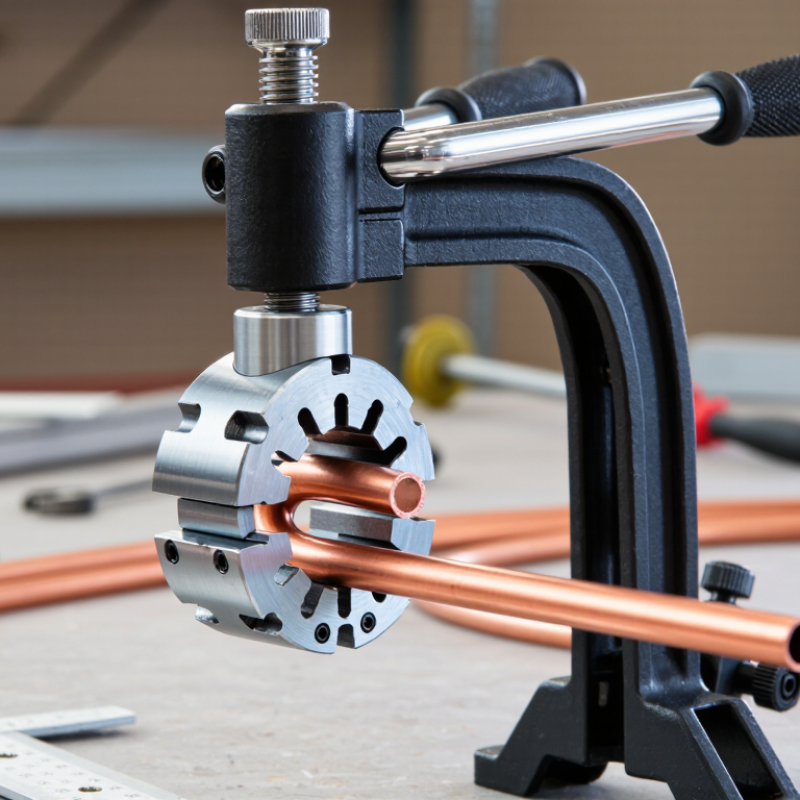
Definition and Purpose of a 3/8-Inch Tube Hairpin Bender
A 3/8-inch tube hairpin bender is a hand or bench tool for forming U-shaped returns in 3/8-inch tubing. It guides the tube around a shaped former, helping create a compact turn between parallel runs. The finished bend resembles a hairpin. Exact sizing matters. Here, 3/8 inch usually means outside diameter, not the tube’s inner opening; check the tool’s markings carefully.
Its purpose is to control bend radius and reduce flattening, wrinkles, or kinks that can restrict flow. A matching groove supports the tube wall as pressure is applied steadily by hand or lever. This is useful when repeated returns must fit a measured space, such as a coil or service assembly. Still, the tool cannot guarantee a clean bend. Material, wall thickness, temper, and bend radius affect the result. Try a short offcut, then inspect both curves for ovaling or wrinkles; forcing it may spoil the final fit. Check twice.
What Is a 3/8-Inch Tube Hairpin Bender?
A hairpin bender forms tubing into a U-shaped return bend, commonly used in coil and heat-exchanger layouts. “3/8-inch” refers to tubing with a nominal outside diameter of 0.375 inches (9.525 mm); confirm the tool’s specifications for the tubing material and wall thickness.
Key Components and Bending Geometry
A 3/8 tube hairpin bender forms a straight tube into a compact U-shaped return bend. Its key components are the forming shoe, tube groove, clamp, and lever. The groove supports the tube while the shoe guides it around a fixed radius. A 3/8-inch outside diameter equals 9.525 mm, using the NIST inch-to-millimeter conversion. That small dimension still leaves little room for a poor fit: the groove should match the tube, not just its nominal size.
Bending geometry determines whether the two legs sit parallel and align with the coil or assembly. The bend radius, straight-leg length, and springback all matter. The Copper Development Association’s Copper Tube Handbook discusses bending in relation to tube material and temper, so there is no single radius that suits every 3/8-inch tube. Wall thickness matters, too. A tight radius may flatten the inside wall or wrinkle the outside curve. Even a neat-looking bend can hide a reduced flow area; I would check the finished shape rather than trust appearance alone.
Tips: Mark the tube’s centerline and intended tangent points before bending. Seat it fully in the groove, then apply steady pressure. Check the two legs against a square or template, and inspect the bend for flattening. Small mismatch? Recheck the setup before making the next one.
How the Tool Forms a Hairpin Bend
A 3/8-inch tube hairpin bender turns straight tubing into a compact U-shaped return, commonly used to connect adjacent passes in refrigeration and heat-exchanger coils. ASTM B280 dimensional data includes 3/8-inch outside-diameter copper tube for air-conditioning and refrigeration service. That measurement describes the tube’s outside diameter, not its wall thickness. The bender’s grooved form supports the tube while a handle draws it around a curved shoe. Small details matter. A correctly matched groove helps reduce flattening and kinks.
To form the bend, seat the tube fully in the groove and align its center mark with the tool’s reference point. Apply steady pressure, keeping the tube from twisting as the curve develops. The Copper Development Association’s Copper Tube Handbook covers controlled tube bending; in practice, support and a suitable bend radius help preserve the tube’s shape. Once released, the legs should sit parallel, with no visible crease at the crown. Even a careful setup can miss by a few millimeters. A test bend can reveal alignment problems before the finished coil is formed.
Common Tube Materials and Applications
A 3/8-inch tube hairpin bender forms tubing into U-shaped returns used in coils and heat exchangers. The measurement usually refers to tube outside diameter, but verify the tool’s capacity before bending. Copper is common in refrigeration and air-conditioning circuits; ASTM B280 covers copper tube intended for these systems. It bends readily, yet thin walls can flatten if the bend radius is too tight. Aluminum tubing also appears in heat-exchanger coils. Its alloy and temper affect springback, so a setting that works for copper may not work here. Stainless steel suits some corrosive or process environments, but its greater springback can demand more force. A clean-looking U is not automatically a sound one.
Applications are closely tied to cooling demand. The International Energy Agency’s 2018 Future of Cooling report projected global air-conditioner stocks rising from 1.6 billion units to 5.6 billion by 2050. The U.S. Energy Information Administration’s 2020 Residential Energy Consumption Survey found that about 88% of U.S. households used air conditioning. These figures describe cooling markets, not bender sales—a distinction worth keeping in mind. In practice, material, wall thickness, and bend radius determine whether a 3/8-inch return stays round and fits the coil layout. Small details matter.
Selecting and Using the Right Bender
What Is a 3/8 Tube Hairpin Bender?
Selecting and Using the Right Bender
A 3/8-inch tube hairpin bender forms a U-shaped return, often used in coils and compact tubing runs. Check what “3/8 inch” means on the tool: it usually refers to the tube’s outside diameter. Match the bender to the tube material, wall thickness, and required bend radius. Copper and soft aluminum bend differently from harder tubing. A tool that fits the diameter can still flatten thin-wall tube.
Before bending, inspect the tube for dents and mark the bend start clearly. Seat the tube fully in the groove, then apply steady pressure through the handle. Avoid jerking; it can kink the inner wall or leave an uneven return. Make a test bend on spare tubing when the radius matters. A small marking error can shift the finished hairpin by several millimeters, which is easy to overlook. Check the bend for flattening, cracks, and alignment before installation.
Tips: Keep the tube clean and supported. Use the correct groove, and do not force a bend that resists. For a tight radius, check the tool’s stated limits first. Tube condition matters too.