Why Choose Ball Valves for Industrial Applications?
Ball Valves are common in industrial systems because their quarter-turn action can open or isolate a line quickly. A handle moves; a bored sphere aligns with the flow path. Turn it again, and the passage closes. Simple to operate. That simplicity matters near pump skids, process tanks, and utility headers, where clear valve position and reliable shutoff support everyday work. Ball Valves are not automatically the right choice for every service, though. Media, pressure, temperature, leakage requirements, and cycling frequency all affect selection.
An illustrative industrial valve specialist, Elena Ward, might put the practical point this way: “A ball valve performs well when its materials, seats, and operating conditions are matched to the service.” Treat that as an editorially written perspective, not a documented quotation. The detail is important: a stainless-steel body, for example, does not by itself establish compatibility with every process fluid. Seat material, seal design, connection type, and maintenance access deserve attention too. Small details matter.
This guide examines why engineers choose Ball Valves for industrial applications, where their fast operation and compact designs can be useful, and what trade-offs deserve a closer look. It also considers how full-port and reduced-port designs affect flow, and why frequent throttling may call for another valve type. Selection should follow verified product data and the actual operating envelope—not habit alone. A good fit is specific. A poor fit can look fine on paper, then create trouble during commissioning or service.
What Is an Industrial Ball Valve?
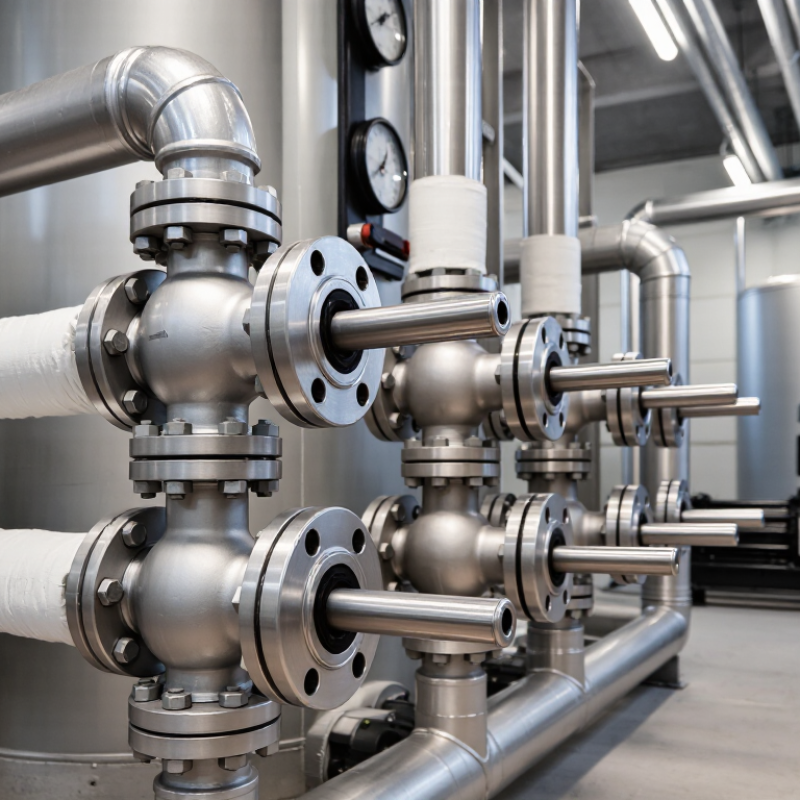
An industrial ball valve controls flow with a drilled, spherical closure element. Turn its stem 90 degrees, and the bore moves into or across the flow path. In the open position, a full-port design can provide a relatively unobstructed passage; in the closed position, the ball presses against seats that help limit leakage. The body, ball, stem, and seats are selected for the fluid, pressure, temperature, and operating cycle. A valve handling clean water may need different materials from one exposed to abrasive slurry or hot process fluid. A practical choice.
Ball valves are common for isolation because they operate quickly and are straightforward to inspect. But they are not automatically suitable for throttling: prolonged operation partly open can wear seats or cause unstable flow, depending on the design and service.
The U.S. Department of Energy’s Improving Compressed Air System Performance: A Sourcebook for Industry estimates that leaks can waste 20–30% of compressor output. That figure applies to compressed-air system leaks overall, not to ball valves alone; still, it shows why seat condition and maintenance matter.
API 598 provides inspection and pressure-testing requirements for valves, while the permitted leakage depends on the specified valve type and test criteria. In practice, confirm the required shutoff level, check the fluid’s compatibility with seat materials, and consider how often operators will cycle the valve. A tight shutoff rating on paper cannot compensate for the wrong service conditions.
How Ball Valves Control the Flow of Media
A ball valve controls media with a bored sphere that turns inside the valve body. At a quarter-turn, the bore aligns with the pipe and allows flow; another quarter-turn blocks it. The opening is easy to inspect, and the handle gives a clear position cue. Small movement matters. When partly open, the ball restricts flow and can create turbulence, noise, and wear. For continuous throttling, a valve designed for modulation may be a better fit.
Sizing helps make the choice less guesswork. Under the ISA/IEC 60534-2-1 sizing convention, a valve’s Cv describes the US gallons per minute of 60°F water that pass with a 1 psi pressure drop. Compare Cv with the required flow and pressure conditions, not just pipe diameter.
The U.S. Department of Energy’s 2006 Improving Pumping System Performance sourcebook estimates that pumping systems use nearly 20% of electricity consumed by industrial motor systems. That is system-wide context, not a ball-valve saving estimate, but it shows why avoidable pressure loss matters.
A detail can be missed: media viscosity, solids, temperature, and frequent cycling all affect performance. Check those conditions before specifying a valve.
What Advantages Make Ball Valves Suitable for Industry?
In industrial service, ball valves offer quick, dependable isolation. A quarter-turn handle moves the ball between open and closed positions, which helps operators act quickly near pumps, tanks, and process lines. Full-bore designs can reduce flow restriction compared with narrower passages. They also have few internal parts, making routine inspection relatively straightforward. Fast isolation. Still, a ball valve is not automatically the best choice for every duty; frequent throttling can wear its seat and affect control accuracy.
Tips: Match the valve body, seats, and seals to the fluid, pressure, temperature, and cleaning routine. Check the manufacturer’s pressure-temperature limits, and confirm whether the valve is intended for isolation or control. A small mismatch can become a persistent leak.
Energy performance matters across large facilities. The International Energy Agency’s Energy Efficiency 2023 report estimates that industry accounted for about 37% of global final energy consumption in 2022. That figure does not measure valve savings, but it shows why reducing avoidable pressure losses deserves attention. Select a full-bore valve where the process requires low resistance, and verify the actual pressure drop in the system design. Ball valves are practical, but installation quality and maintenance still decide how well they perform.
Why Choose Ball Valves for Industrial Applications?
A typical quarter-turn design moves from open to closed with a 90° rotation, enabling fast operation.
Ball valves are suited to many industrial services because quarter-turn operation allows quick shutoff. Depending on the design, they can provide tight shutoff and full-port flow paths; pressure, temperature, and media compatibility should be checked for each application. The angles shown are typical quarter-turn travel.
Where Are Ball Valves Used in Industrial Systems?
Ball valves are used in gas processing plants, compressor stations, metering skids, and pipeline branch connections. Their quarter-turn action allows operators to isolate a section quickly during maintenance. The U.S. Energy Information Administration describes a natural gas pipeline network spanning more than three million miles. That scale makes dependable isolation important, though a ball valve is not automatically the right choice for every duty. It is generally better for on-off service than for precise flow control.
Water and wastewater systems use ball valves around pumps, treatment units, and cooling-water loops. The USGS report Estimated Use of Water in the United States in 2015 recorded withdrawals of about 322 billion gallons per day nationwide. That figure includes many uses, including power generation; it is not a measure of water handled by treatment plants alone. In a pump room, a compact valve can simplify isolation, but suspended solids, corrosion, pressure, and temperature still matter. Not every line fits. Selection can be underestimated: check the fluid and operating conditions before specifying materials or seat design.