
A Digital Watch is more than a screen on your wrist. It can show the time clearly, track a workout, set an alarm, or keep a second time zone close at hand. For many people, the appeal is practical: glance at a bright display while crossing a station, press a button with cold fingers, and move on. No winding. No guesswork. Still, choosing one depends on how you live, not on the number of features listed on the box.
Casio engineer Kikuo Ibe, who developed the G-Shock, is widely associated with this design goal: “I wanted to make a watch that would not break even if dropped.” That idea points to a useful question: what do you need your watch to withstand? Case protection, water resistance, battery life, display readability, and comfortable buttons all deserve a closer look. Specifications matter, but they do not tell the whole story. A large watch may feel clumsy beneath a jacket cuff, and a feature-rich model can be frustrating if its menus are hard to use.
This guide explores why people choose digital watches, which features offer everyday value, and where their limits show. Some readers may prefer the simplicity of an analog dial. Fair enough. The better choice is the one that fits your routine, budget, and wrist, rather than the one with the longest feature list.
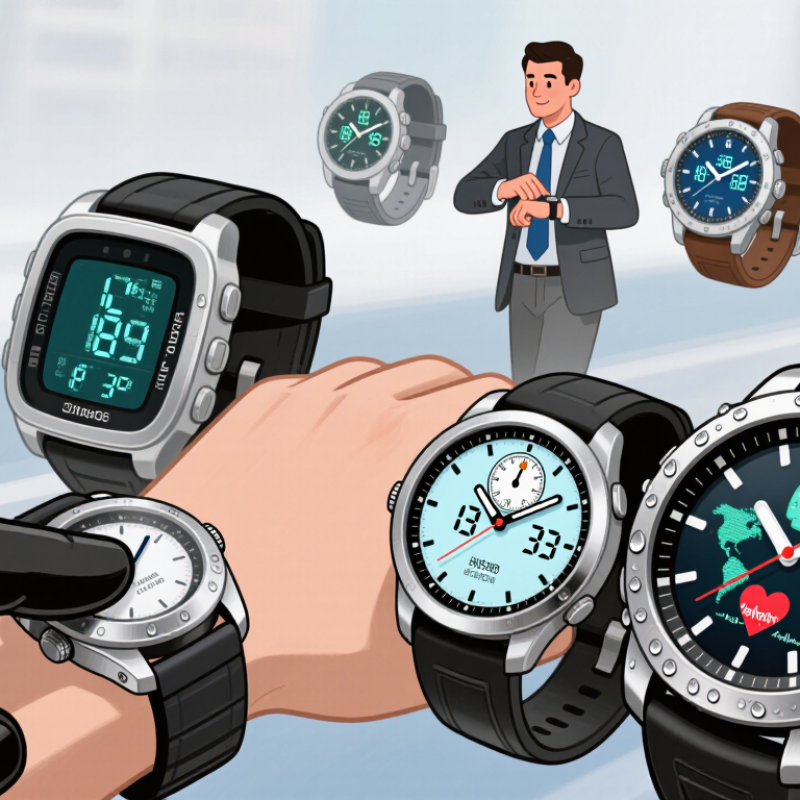
A digital watch turns a tiny electrical rhythm into digits you can read at a glance. In many models, a quartz crystal vibrates 32,768 times per second when powered. A divider circuit halves that frequency 15 times, producing one pulse per second. Counters then track seconds, minutes, and hours, while a display driver lights the matching liquid-crystal segments. The result is precise-looking time, shown clearly on a small screen.
The time unit behind that display has a rigorous reference. The BIPM’s 2019 International System of Units brochure defines one second using 9,192,631,770 cycles of radiation from a cesium atom. A watch’s quartz crystal does not use that atomic process; its electronics count regular vibrations and may need occasional correction. That distinction matters. A bright backlight, weak battery, or temperature change can affect everyday use, and a digital display cannot make a watch perfectly accurate. Still, reading “7:42” is simpler than interpreting moving hands in a dim room. A small trade-off. Digits are direct, though the display can feel less intuitive when it fails.
A digital watch may look simple, but its steady display depends on a tiny vibrating crystal. Many quartz movements use a crystal oscillating 32,768 times per second. That number is useful because it can be divided by two repeatedly, through 15 stages, to produce one pulse per second. The watch’s circuit counts those pulses and updates the display.
Small part. Precise rhythm.
The process turns an almost invisible vibration into a clear change on the screen. You can see the result when seconds advance while a watch rests beside a quiet desk lamp. Digital displays also make minutes and alarms easy to read at a glance, though not every model offers the same features or accuracy. The crystal is one part of a larger system, not a guarantee of perfect time.
Quartz watches can still gain or lose time. Temperature changes, aging components, and physical shocks may affect performance, and the amount varies by movement. A watch that seems slightly off is not necessarily defective; checking it against a reliable time source over several days gives a better picture. This detail is easy to overlook. The number 32,768 sounds exact, but real-world timekeeping depends on how well the entire movement is built and maintained.
A digital watch is useful because it asks little of its owner. A maker’s rating of about seven years from one battery makes that convenience tangible. You can leave it on a bedside table, wear it through a workday, and check the time without charging it each night. Seven years is a rating, not a promise. Frequent alarm or backlight use, temperature, and battery variation can shorten that span. The small display may feel plain beside a phone, but it is quick to read at a glance. No scrolling required.
Longer intervals between battery changes also mean less routine maintenance, though they do not make a watch impact-free. The Global E-waste Monitor 2024, produced by UNITAR and the International Telecommunication Union, estimates that 62 million tonnes of electronic waste were generated worldwide in 2022; just 22.3% was documented as formally collected and recycled. That report covers all e-waste, not watches alone, so a single watch cannot meaningfully shift the global figure. Still, fewer battery changes are a modest practical advantage. A small caveat remains: battery life is easy to quote, harder to guarantee in everyday use.
A digital watch is useful when you want clear numbers, quick alarms, and a timer at a glance. Yet its water-resistance marking deserves a closer look before you wear it near a pool or sink. ISO 22810:2010 sets requirements and test methods for water-resistant watches. That matters.
The standard uses controlled procedures to assess how a watch responds to water exposure. Tests can include condensation checks, immersion, and pressure exposure. These results help support a stated water-resistance level, but they do not promise that every watch suits every activity. A laboratory test is not the same as repeated use in a shower, a hot tub, or fast-moving water. Small differences matter.
Check the watch’s instructions alongside its marking. Some models should not have buttons pressed while submerged, since water may enter through the controls. Heat, soap, and aging seals can also affect protection over time. A digital display may remain readable underwater, but that does not prove the case is suitable for swimming. I would treat the rating as useful evidence, not a dare. Even careful users can misunderstand it. When the intended activity is unclear, ask the seller or manufacturer for the exact limits and care guidance.
| Topic | Data or benchmark | Practical meaning | Important limitation |
|---|---|---|---|
| Water resistance and ISO 22810:2010 | |||
| Standard scope | ISO 22810:2010 specifies requirements and test methods for water-resistant watches. | It provides a basis for evaluating a watch’s water resistance under defined test conditions. | A standard test result does not mean a watch is suitable for every water-based activity. |
| Typical water-resistance markings | Common markings include 3 bar, 5 bar, 10 bar, and 20 bar. One bar is approximately 100 kPa. | The marking indicates a pressure rating associated with testing; check the watch documentation for its exact meaning. | These are common market markings, not a guarantee of a particular safe swimming or diving depth. |
| Pressure-to-depth conversion | In still water, pressure increases by approximately 1 bar for every 10 metres of depth, in addition to atmospheric pressure at the surface. | This explains why labels such as “30 m” or “100 m” are often used as approximate pressure equivalents. | Real movement, impact, water jets, and temperature changes can create conditions unlike static laboratory pressure. |
| 3 bar / approximately 30 m marking | A commonly used entry-level water-resistance marking. | May be suitable for incidental splashes when the manufacturer’s instructions allow it. | Do not assume it is suitable for swimming, showering, or submersion. |
| 5 bar / approximately 50 m marking | A common rating on everyday watches. | Some models may be suitable for surface swimming when their instructions explicitly permit it. | Activity guidance varies by model; do not infer suitability from the number alone. |
| 10 bar / approximately 100 m marking | A higher common rating than 5 bar. | May suit more water-oriented use, subject to the manufacturer’s stated limits. | A depth equivalent is not an authorization for scuba diving or for pressing buttons underwater. |
| 20 bar / approximately 200 m marking | A high common pressure marking. | Offers a higher stated pressure rating than lower-marked watches. | Do not treat the marking alone as proof that the watch is a diving instrument or complies with a separate diving-watch standard. |
| Buttons and water | Button operation can affect water resistance on many watches. | Follow the model’s manual; keep buttons and the crown in their specified positions before exposure to water. | Do not operate buttons underwater unless the manufacturer specifically says that it is safe. |
| Condition over time | Seals and gaskets can deteriorate through aging, wear, impact, or servicing. | Periodic inspection or pressure testing can help confirm continued water resistance. | A watch’s original rating may not describe its current condition after years of use or repair. |
| Why choose a digital watch? | |||
| At-a-glance information | Digital displays can show numerals, dates, alarms, timers, and other functions, depending on the model. | Useful when quick reading or several timekeeping functions are priorities. | Features and display readability vary by model, lighting, and viewing angle. |
| Timing functions | Many digital watches offer a stopwatch, countdown timer, or both. | Can help with workouts, cooking, study sessions, and everyday reminders. | These functions do not replace dedicated professional timing or measurement equipment where required. |
| Water-related use | Water suitability depends on the watch’s stated rating, condition, and operating instructions—not on whether its display is digital or analog. | Choose a digital model whose documented water resistance matches the intended activity. | Always check the specific model’s manual and have its seals checked when appropriate. |
| Choosing by activity | Match the manufacturer’s activity guidance to the planned exposure: splashes, swimming, or more demanding water use. | A clear activity match is more useful than choosing by a depth number alone. | When guidance is unclear, contact the manufacturer or avoid exposing the watch to water. |
Note: Approximate metre equivalents are pressure conversions, not guaranteed usable diving depths. Always follow the watch’s own instructions and care guidance.
Why Should You Choose a Digital Watch?
A digital watch can make everyday timing easier, especially when you need to read the time at a glance. Large numerals are useful in dim hallways or during a quick workout, while a backlight helps after sunset. Check that the display stays readable from different angles. Some screens look sharp indoors but become harder to see in bright sunlight. Alarms matter too: one daily reminder may be enough, but multiple alarms help separate medication reminders, meetings, or practice sessions.
Tips: Try the buttons before choosing. Can you set an alarm without searching for instructions? A simple menu can save frustration. Still, a loud alarm may be awkward in a quiet room.
A stopwatch is handy for tracking laps, cooking, or short study sessions. Look for clear start, stop, and reset controls; tiny buttons can be fiddly when your hands are wet. Battery life deserves equal attention. A basic display may run longer than features that use frequent lighting or extra functions, but actual life varies by model and use. Check the stated battery type and replacement guidance. I sometimes overvalue extra functions, then leave them untouched. Choose the tools you’ll actually use, and accept that no watch is perfect.
Join our mailing list to receive the latest news and updates from our team.