
A modern Potato Chips Production Line is more than a row of stainless-steel machines. It is a carefully balanced process, from washing and peeling to slicing, frying, seasoning, and packaging. Each stage affects the next. A slice that is too thick may fry unevenly; excess moisture can change texture and oil uptake. Small details matter.
This introduction uses a clearly illustrative expert voice, not a verified quotation: process engineer Lena Hart says, “A good line protects the potato, not just the output rate.” That principle offers a useful way to assess manufacturers worldwide. Look beyond advertised capacity. Compare cutting consistency, fryer temperature control, seasoning distribution, cleaning access, automation options, and after-sales support. Ask how suppliers validate performance with the varieties and operating conditions you actually use. The demonstration should include real samples. Not just diagrams.
The manufacturers covered in this topic serve different production scales and priorities. Some focus on high-throughput, integrated systems; others offer modular equipment for gradual expansion. No supplier is best for every factory. A polished brochure cannot show every maintenance challenge, and specifications alone may hide trade-offs in energy use or product changeovers. This overview therefore considers practical capabilities alongside technology claims. It also leaves room for uncertainty: line performance depends on installation, training, raw potatoes, and daily operating discipline. Choosing well takes evidence, not only impressive numbers.
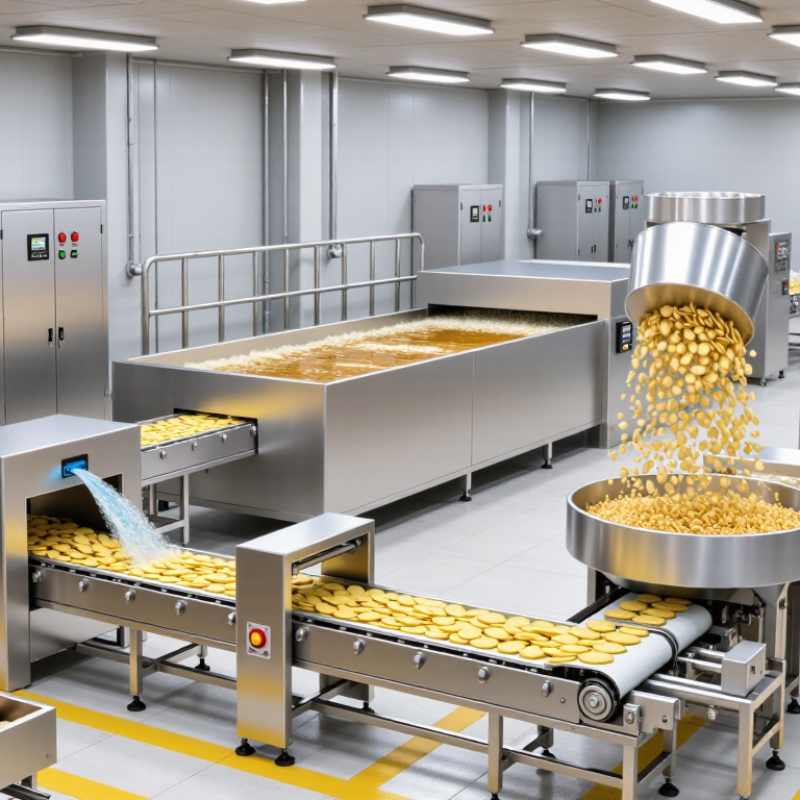
Potato chips production lines turn a variable farm crop into a consistent packaged food. FAOSTAT’s Crops and Livestock Products database records about 374 million tonnes of potatoes harvested worldwide in 2022. That figure covers potatoes, not chips, but it shows the scale of the raw-material supply behind processing plants.
A typical line links washing, peeling, slicing, rinsing, frying, seasoning, and packing. Each stage affects the next. Uneven slices can fry at different rates; excess surface starch may darken the oil sooner. Operators monitor slice thickness, fryer temperature, oil quality, and moisture, while conveyors and sensors help maintain a steady flow. Small details matter. A few seconds of excess frying can change color and crunch.
In food manufacturing, automation supports repeatable output and helps workers handle hot oil and moving equipment more safely. Still, a fast line is not automatically a better one. Poorly matched slicers, fryers, and packers can cause bottlenecks, breakage, or unnecessary waste. Plant teams need to check real production records, not only supplier capacity claims. That part is easy to overlook. Product variety, potato size, and seasonal changes can all affect performance.
A potato chips production line starts with sorting, washing, and peeling. Operators remove stones and damaged potatoes before slicing. A rotary slicer creates thin, even cuts; inconsistent slices can fry at different speeds. Rinsing removes surface starch, while a dewatering unit shakes off excess water. Some lines add blanching, depending on the potato variety and desired texture.
The slices move through a continuous fryer, where controlled oil temperature and belt speed help produce an even golden color. Oil filtration limits crumbs and supports consistent frying. After draining and cooling, a seasoning drum coats chips with measured amounts of salt or other flavorings. Weighing and packing equipment then fills bags and seals them. Small process changes matter. Potato moisture can vary by season, so fixed settings may not always deliver the same crispness.
Tips: Check slice thickness and fryer temperature during each shift. Look for pale centers, excess oil, or broken chips. Keep a simple batch log; it may reveal patterns that operators miss during a busy run.
Potato chip production lines vary by cutting method, heating system, and output capacity. A standard sliced-chip line washes, peels, and slices whole potatoes before removing surface starch and frying them. Continuous fryers suit steady, high-volume production. Batch fryers offer more flexibility for small runs and varied recipes.
Small runs matter.
Kettle-style lines fry thicker slices more slowly, creating a firm bite and uneven, rustic appearance. They are often used for premium-style chips, but their longer cooking cycles can limit throughput.
Thin, uniform slices work well on high-speed lines, where consistent thickness helps control color and crispness.
Heat changes everything.
Baked-chip lines use hot air rather than deep frying, and may suit products positioned around a different texture or cooking method. Formed-chip lines process potato flakes or other prepared ingredients into shaped pieces, which can reduce dependence on whole-potato size and shape.
Applications also depend on seasoning and packaging equipment. A simple salted product needs less complex coating than chips carrying fine powders or heavier flavors. Operators should check how seasoning adheres after cooling; a good-looking sample can still lose flavor in the bag. Line capacity, available floor space, cleaning access, and local potato characteristics all affect the choice. A neat specification sheet rarely captures every production difficulty. Slicing trials and small pilot batches can reveal problems before a full installation.
Major potato chips production line manufacturers worldwide build equipment for plants ranging from regional snack factories to high-volume operations. Their systems may include washing, peeling, slicing, blanching, frying, seasoning, and packaging. FAO’s World Food and Agriculture Statistical Yearbook 2024 reports global potato production of about 374 million tonnes in 2022. That is a vast raw-material base, but supply varies by season, variety, and growing region.
Manufacturers across Europe, Asia, and North America serve different production needs. Some focus on compact lines with manual checks; others engineer continuous systems with automated feeding and temperature controls. Details matter. A consistent slice thickness helps control frying time, while effective oil filtration can support product quality and reduce waste. Buyers should examine throughput, energy use, cleaning access, and local technical support—not just the advertised hourly capacity.
A line designed for one potato variety may need adjustment for another. This is easy to overlook. FAO’s production figures describe crop volume, not the share suitable for chip processing, so they cannot predict factory demand on their own. Before choosing a supplier, processors can request trial runs using their own potatoes and review performance data for yield, breakage, and oil use. Real factory conditions may differ from a neat demonstration.
| Manufacturer category | Global market presence | Typical equipment supplied | Common production-line features | Best suited to |
|---|---|---|---|---|
| Turnkey line manufacturers | Suppliers operate across major food-processing equipment markets worldwide. | Integrated systems covering potato feeding, washing, peeling, slicing, frying, seasoning, and packaging interfaces. | Coordinated equipment design, line controls, and commissioning support; layouts are typically configured for the factory and target output. | Projects seeking a single supplier for most of the production process. |
| Frying-system specialists | Available in established food-processing equipment markets in Europe, North America, and Asia. | Continuous fryers, oil circulation and filtration equipment, heat-recovery options, and fryer controls. | Designed to manage frying temperature, oil flow, residence time, and product throughput. | Processors upgrading frying capacity or integrating a specialist fryer into an existing line. |
| Preparation and slicing equipment manufacturers | Equipment is supplied to snack factories in potato-producing and potato-processing regions worldwide. | Potato washers, destoners, peelers, inspection conveyors, slicers, and blanching equipment. | Equipment selection depends on potato condition, slice thickness, product style, and the required line speed. | Plants focused on raw-potato handling, consistent slicing, or replacement of preparation equipment. |
| Seasoning and conveying equipment manufacturers | Suppliers serve both new factories and existing snack-production plants internationally. | Oil sprayers, seasoning drums, powder dosing equipment, conveyors, and product distribution systems. | Can be configured for even seasoning application and integration with frying, cooling, and packaging stages. | Manufacturers adding flavors, improving product handling, or modifying downstream line sections. |
| Packaging-line manufacturers | Global suppliers support snack producers across a wide range of factory sizes. | Weighers, vertical form-fill-seal machines, bag conveyors, and case-packing equipment. | Packaging format and speed must be matched to the product, bag size, and upstream production rate. | Plants requiring an integrated packing section or higher finished-product handling capacity. |
| Small and mid-scale line suppliers | Commonly found in regional equipment markets and in suppliers serving emerging snack businesses. | Compact or modular washing, slicing, frying, seasoning, and packing equipment. | Modular layouts can allow capacity expansion by adding or replacing selected stages. | New businesses, pilot facilities, and producers with limited factory space or investment budgets. |
| Large-scale industrial line suppliers | Serve high-volume snack manufacturers in multiple regions. | High-throughput preparation, continuous frying, automated seasoning, conveying, and packaging systems. | Often designed around automated controls, process monitoring, sanitation requirements, and factory-specific layouts. | Established producers seeking high-volume, continuous operation. |
| Custom-engineered line providers | Work with food manufacturers internationally on project-specific installations. | Selected combinations of preparation, frying, seasoning, cooling, and packaging equipment. | Specifications are developed around product type, available utilities, floor plan, food-safety requirements, and target output. | Factories with unusual building constraints, specialized products, or existing equipment to retain. |
Note: The table compares manufacturer categories and common equipment capabilities rather than ranking individual companies. Actual line capacity, automation, and supplied equipment vary by project and configuration.
Comparing potato-chip production line manufacturers starts with the product, not the brochure. FAOSTAT recorded about 375 million tonnes of potatoes worldwide in 2022; this broad crop figure is not a chips-market estimate. It does show why tuber quality and seasonal variation deserve attention. Ask each manufacturer to trial your actual potato variety and slice thickness. Measure usable output after peeling, slicing, frying, and seasoning—not just the headline capacity. Small test batches matter.
Compare written guarantees for output, slice consistency, oil use, energy consumption, and changeover time. Request reference installations with similar products and operating hours. During a factory acceptance test, check whether the line handles uneven tubers without frequent stops. Also inspect cleaning access, spare-part lead times, and operator training. A spreadsheet can still miss these details. The uncomfortable part: the cheapest quote may exclude conveyors, installation, or commissioning. Ask for a full delivered-cost breakdown and a clear service plan. Then compare total cost per saleable kilogram, not purchase price alone.
Compare manufacturers by matching a line’s rated throughput to your target output. These indicative capacity ranges describe small, medium, and large-scale lines; actual output depends on potato variety, slice thickness, frying conditions, and product specifications.
Use these ranges as an initial planning guide, not as guaranteed specifications. Request each supplier’s rated capacity and expected output for your specific product and operating conditions.
Join our mailing list to receive the latest news and updates from our team.